
What Is Physical AI Infrastructure, and Where Does Identity Fit?

Artificial intelligence can classify an object in a camera image. A robot can plan a route around it. Neither capability, by itself, tells the system which specific asset, location, or instruction it has encountered.
That distinction matters when a machine must act on the right physical target. An autonomous system may detect a landing area but still need to confirm that it is the designated one. A product-authentication application may recognize a product type but need the identity of the particular marked item before it can retrieve the relevant verification record.
Physical AI infrastructure is the collection of technologies that makes such real-world operation possible. It includes far more than a visual marker or an identity system. Identity is one component with a precise job: connecting what a machine observes to a specific, persistent digital identity that other systems can use.
What is Physical AI infrastructure?
Physical AI infrastructure comprises the data, computing, simulation, models, sensors, identity systems, software integration, and physical equipment needed to develop, deploy, and operate AI systems in the real world. Its components vary by application. A robot arm, a drone, and an industrial inspection system do not require identical architectures.
The term covers two related environments:
Development infrastructure: data collection, model training, simulation, testing, and computing resources.
Operational infrastructure: cameras and other sensors, perception and decision software, identity and context, connections to systems of record, and the equipment that executes an action.
This broader scope is visible in the industry. NVIDIA describes a robotics platform spanning models, simulation frameworks, accelerated libraries, and computing. AWS Guidance for Physical AI for Robotics likewise covers simulation and real-world training. These are substantial parts of the infrastructure picture. They are not Sodyo's role.
Where identity fits in the operational system
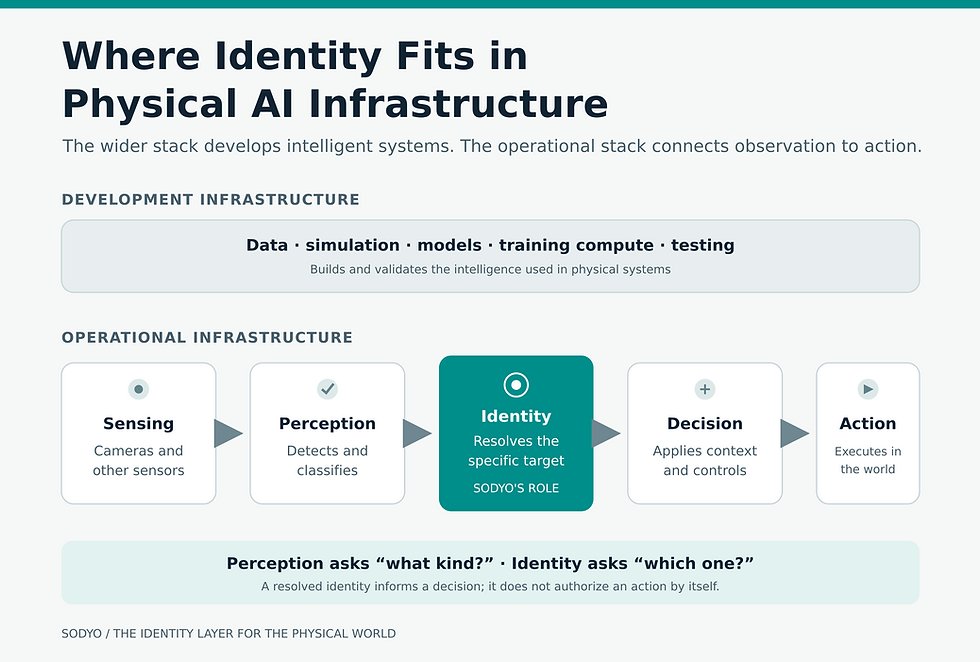
At deployment, a Physical AI system often has to answer a sequence of different questions:
Sensing: What signals are present?
Perception: What kind of object or scene am I observing?
Identity resolution: Which specific marked asset, location, or instruction is this?
Context and decision: What does its current record mean, and what should happen?
Action: How should the system execute and verify the response?
The boundaries matter. A vision model may classify a landing area without identifying the particular landing target assigned to a drone. A resolved identifier can point to that target's record, while navigation and flight-control systems determine whether an approach is permitted and safe.
Identity resolution is the link between perception of a physical target and its digital record. In environments where the specific target matters, omitting that link forces the system to infer identity from appearance, position, or surrounding context. Those signals can be useful, but their reliability depends on the task and conditions.
For a deeper account of these boundaries, see What Infrastructure Is Required for Physical AI.
Why a digital record is not enough
Enterprise systems already assign IDs to products, equipment, locations, and work orders. The harder problem is connecting a live physical observation to the correct record.
Consider two similar assets in the same workspace. The database can distinguish them. A camera may see both, and a model may classify both correctly, yet the operating system still needs an observable way to resolve which asset is which. A machine-readable identifier can provide that connection when it can be detected under the relevant operating conditions and tied to a maintained identity record.
This is why the identity layer has to be designed for the physical environment, not only for the database. Distance, angle, motion, lighting, marker placement, visibility, and reacquisition all affect whether a system can read the intended target. The application also needs rules for missing, conflicting, or stale identity information. Identity cannot be treated as a one-time lookup if the physical asset and its digital record change over time.
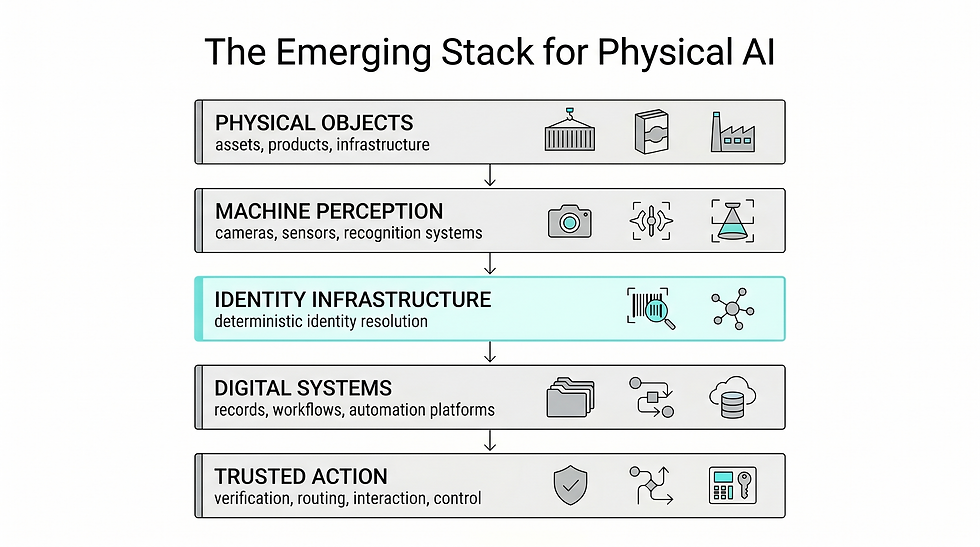
The broader layered architecture is covered in The Emerging Stack for Physical AI. The narrower question here is where a specific physical observation becomes a specific digital identity.
Sodyo's place in the stack
Sodyo builds the infrastructure that gives physical objects persistent digital identity. Its platform combines a proprietary visual marker system, computer vision recognition stack, and identity resolution protocol. A camera observes a marked target; the recognition system reads its identity; the resulting identity can be connected to a controlled digital record and the relevant application workflow.
Sodyo contributes the physical identity layer. It does not train a robotics foundation model, provide the robot's motion controls, or replace an enterprise system of record. Its role is to help those systems establish which marked physical target they are dealing with.
That shared platform supports distinct vertical solutions. Qapture applies it to interactive engagement, such as connecting a broadcast or outdoor touchpoint to a digital experience. Verimark applies it to product authentication and brand protection. RangeMark applies it to target identity for autonomous systems, including precision landing. Zimark applies it to logistics. Their applications, buyers, and workflows remain distinct even though they draw on the same underlying identity architecture.
This role also explains why the relevant comparison is not simply “Which code scans better?” The architectural question is whether a system can reliably resolve the intended physical target and carry that identity into the right digital workflow under the conditions in which it operates. For the distinction between category recognition and specific identity, see What Is Physical AI.
Questions to ask when designing the identity layer
An identity component should be evaluated within the complete operational system:
Target: Which assets, locations, or instructions must be individually distinguishable?
Observation: At what distance, angle, speed, and visibility must the target be detected or reacquired?
Resolution: What identifier does the recognition system return, and how is it associated with the correct record?
Continuity: What happens when the target moves, the record changes, or the camera temporarily loses sight of it?
Control: Which system checks status, permissions, and conditions before an action occurs?
Failure: How does the system respond when no identity is resolved, multiple candidates appear, or the record cannot be reached?
These questions turn an abstract infrastructure discussion into a testable architecture. They also prevent a common category error: treating a successful detection, a resolved identity, and an authorized action as though they were the same event.
The infrastructure question Physical AI must answer
Physical AI needs models, simulation, computing, sensing, decision software, and machines capable of acting. Some applications also need a dependable way to identify the particular physical target in view and connect it to a persistent digital record.
That is where Sodyo fits. It provides identity and recognition infrastructure for that physical-to-digital step, while other parts of the stack supply perception, reasoning, systems of record, and execution. The result is a clearer division of responsibility and a practical question for any deployment: when the system sees something, how does it know exactly which thing it is?
If you are building a system that must resolve the identity of physical targets, talk to Sodyo about the operating conditions and integration requirements your deployment needs to meet.


Comments