
What Infrastructure Is Required for Physical AI


Introduction
Artificial intelligence has transformed how machines process information. Modern AI systems can analyze vast amounts of data, interpret complex patterns, and generate sophisticated predictions.
Most of these systems operate entirely in digital environments.
When AI systems interact with the physical world, however, a different set of challenges emerges.
Machines must recognize objects, determine what they are interacting with, and decide what actions to take. In many environments, this process remains unreliable because physical objects rarely possess a clear and consistent machine-readable identity.
As AI increasingly moves beyond software environments into robotics, automation, logistics, and smart infrastructure, this limitation becomes more significant.
Physical AI systems require infrastructure that allows machines to reliably interpret and interact with the physical environment.
What Is Physical AI
Physical AI refers to artificial intelligence systems that interact directly with the physical world.
These systems do not operate solely on digital data. Instead, they observe physical environments through sensors, cameras, and other inputs, and then make decisions about real-world objects and actions.
Examples include:
autonomous robots operating in warehouses
automated inspection systems in industrial environments
smart infrastructure managing equipment and assets
AI-driven logistics systems coordinating physical goods
In each of these environments, machines must determine what physical objects they are interacting with before they can make reliable decisions.
Without reliable identity resolution, this process becomes uncertain.
Why Physical Environments Are Difficult for AI Systems
Digital systems operate in environments where identity is well defined.
Servers have identifiers.
Users have accounts.
Devices possess unique addresses.
Software systems rely on these identity structures to determine permissions, ownership, and actions.
Physical environments rarely operate this way.
Objects may appear visually similar. Labels may be copied or replaced. Environmental conditions may vary. Multiple items may share the same visible characteristics.
As a result, AI systems often rely on probabilistic recognition methods, such as computer vision models that estimate what an object might be.
While this approach works for many tasks, it becomes problematic when systems must determine the precise identity of an object.
In environments such as infrastructure management, logistics operations, or automated systems, uncertainty about identity can lead to operational errors.
The Missing Infrastructure Layer
The challenge facing Physical AI is not simply a software problem.
It is an infrastructure problem.
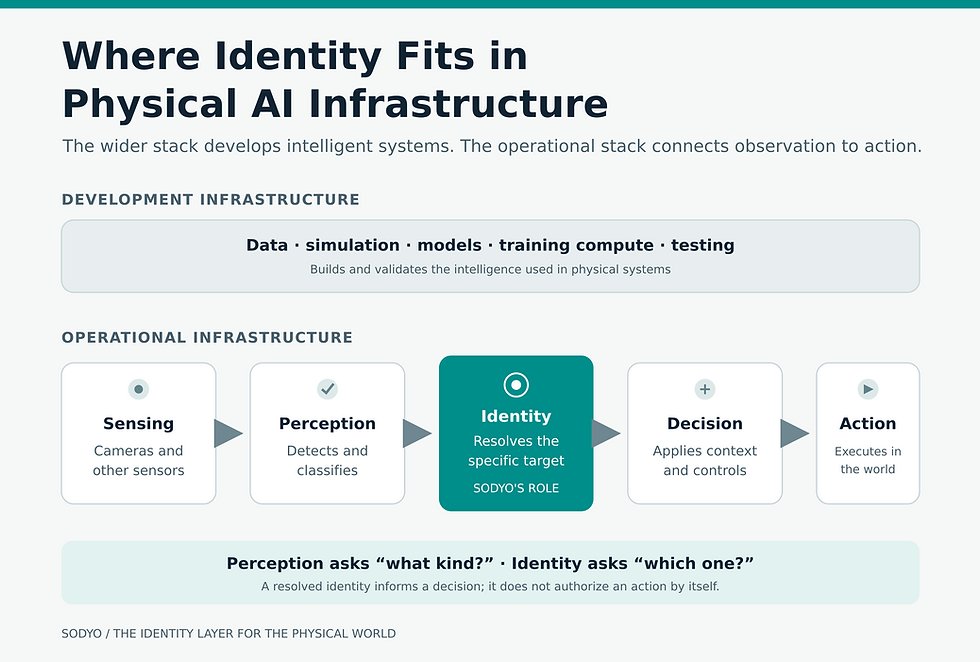
For machines to reliably interact with the physical world, they require systems that allow them to determine the identity of the objects around them.
This requires infrastructure capable of connecting three domains:
Physical objects
Machine perception systems
Digital identity records
When these systems operate together, machines can resolve the identity of an object and determine how it should be handled within a digital system.
Without this infrastructure, physical environments remain difficult for automated systems to interpret reliably.
Key Components of Physical AI Infrastructure
Building infrastructure that enables AI systems to interact reliably with physical environments requires several technical components.
Machine Perception Systems
Sensors, cameras, and computer vision systems allow machines to observe and interpret the physical environment.
These systems provide the raw information that AI models use to recognize objects and understand their surroundings.
Machine-Readable Identity Markers
Physical markers or identifiers that allow machines to detect and distinguish specific objects.
Unlike traditional labels designed for human readability, these markers are designed to be interpreted by machine vision systems operating in real-world environments.
Identity Resolution Systems
Software platforms that determine which digital identity corresponds to a physical object observed by a machine.
These systems connect the physical identifier detected by a camera or sensor with the digital records associated with that asset.
System Integration Layers
Infrastructure that connects identity systems with enterprise platforms, operational databases, or automation software.
This allows machines not only to recognize objects but also to trigger appropriate actions within digital systems.
From Recognition to Deterministic Identity
Many current AI systems rely on probabilistic recognition.
For example, a vision model may determine that an object appears to be a specific type of component or product.
In some environments, however, machines must know exactly which object they are interacting with.
Logistics systems must identify specific packages.
Infrastructure systems must recognize specific assets.
Automation platforms must verify the exact components being handled.
This requires deterministic identity systems that allow machines to resolve identity directly from the physical environment.
Such systems form a foundational layer for reliable interaction between AI systems and physical assets.
The Role of Identity in Physical AI
As AI systems increasingly operate within real-world environments, the ability to resolve identity becomes a central capability.
Machines must determine:
what object they are interacting with
whether the object is trusted
which digital system it belongs to
what actions should occur next
Without a reliable identity layer, these decisions remain uncertain.
Infrastructure that enables machines to deterministically resolve identity therefore becomes a critical foundation for Physical AI.
The Emergence of Machine-Readable Environments
The long-term development of Physical AI will likely involve environments that are increasingly designed to be interpreted by machines.
Physical infrastructure may incorporate identity markers, sensors, and digital integration layers that allow automated systems to interact with objects more reliably.
In these environments, machines will not rely solely on visual estimation. Instead, they will be able to determine the identity of physical assets with much greater certainty.
This shift represents an important step toward making physical environments more accessible to automation systems.
Conclusion
Artificial intelligence has made remarkable progress in digital environments, where identity and structure are clearly defined.
The physical world presents a different challenge.
Objects do not naturally possess digital identities, and machines often struggle to determine exactly what they are interacting with.
For AI systems to operate reliably in physical environments, new forms of infrastructure must emerge that allow machines to resolve identity directly from the physical world.
These systems will form a critical foundation for the next generation of automation, robotics, logistics, and smart infrastructure.
Physical AI will not depend only on advances in algorithms.
It will also depend on the development of infrastructure that makes the physical world more intelligible to machines.


Comments