
Beyond QR: Why Physical AI Requires Trusted Identity Infrastructure

Updated: Mar 30
For decades, machine-readable codes such as QR and DataMatrix enabled connectivity between physical objects and digital systems. They allowed links to be opened, content to be accessed, and interactions to be measured at scale.
That shift transformed marketing, logistics, packaging, and information access. Physical objects became gateways to digital content.
But connectivity alone does not create trust.
As these codes became widespread, a structural weakness emerged. The same simplicity that made them scalable also made them easy to copy. A printed symbol could be duplicated, replaced, or redirected without detection.
In environments where trust matters, that limitation becomes critical.
The Trust Gap
Today, the global counterfeit economy exceeds $2.3 trillion, affecting industries from pharmaceuticals and luxury goods to electronics, packaging, and media.
But counterfeiting is not only a product problem. It is an identity problem.
What is broken is not connectivity.
What is missing is reliable identity.
Traditional machine-readable systems connect users to destinations. They do not verify whether the physical object initiating that connection is authentic.
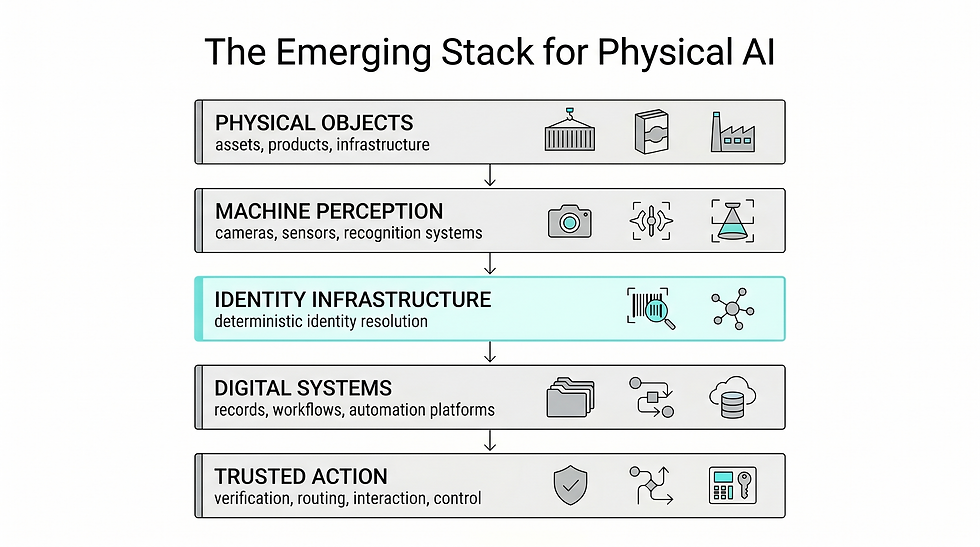
As digital systems extend deeper into the physical world, identity becomes the missing infrastructure layer.
From Connectivity to Identity
Connectivity solves access. Identity solves trust.
In digital environments, identity is foundational. Systems rely on authentication, encryption, and verification to determine what is legitimate. Without identity, trust collapses.
Physical environments are now undergoing the same transition.
Physical AI systems require the ability to assign persistent identity to objects, locations, packaging, and surfaces. Without identity, systems depend on references that can be copied or redirected without detection.
This is where traditional codes reach their architectural limits.
Readable symbols enable interaction. But trusted identity requires infrastructure capable of resolving what is real, not just what is readable.
That distinction defines the next phase of physical-digital systems.

A New Trust Layer for Physical Systems
Establishing trust in physical environments requires more than visual readability. It requires identity markers designed to support deterministic recognition under real-world conditions.
This includes environments where:
objects are moving
lighting conditions vary
surfaces differ
distances are significant
duplication attempts are possible
Physical AI systems depend on recognition infrastructure that can detect, decode, and resolve identity reliably across these variables.
This shift represents a transition from simple linking systems to identity-based interaction frameworks.
Instead of asking:
"What link does this code point to?"
Systems begin asking:
"What object am I interacting with?"
That question defines the foundation of trusted physical systems.
Identity Infrastructure Across Real-World Environments
Trusted identity systems are not limited to a single industry. They operate across environments where verification, attribution, and reliability are essential.
In packaging and product environments, identity infrastructure enables verification of authenticity without relying on easily duplicated references.
In media and broadcast environments, trusted interaction requires reliable recognition of visual signals across screens, distances, and formats.
In logistics and supply chain environments, identity persistence supports traceability across multiple locations and handling stages.
In public infrastructure environments, trusted interaction depends on consistent resolution of identity across distributed physical assets.
These environments differ operationally, but they share the same structural requirement:
trusted identity in the physical world.
From Infrastructure to Implementation
While identity infrastructure defines the foundation, its value becomes visible through vertical implementations designed for specific operational environments.
One example is Verimark, a security and governance layer built on top of Physical AI identity infrastructure.
Verimark applies identity resolution to environments where authenticity and verification are mission-critical, including product authentication, brand protection, and regulated supply chains.
By separating infrastructure from implementation, systems can scale across industries while maintaining consistent identity resolution capabilities.
This layered approach allows innovation at the application level without compromising the integrity of the underlying identity infrastructure.
Beyond Readability: Deterministic Resolution
Most traditional recognition systems rely on probabilistic interpretation. They determine what something likely represents.
Physical AI infrastructure requires a different model.
It must determine what something definitively represents.
This shift introduces the concept of deterministic identity resolution, where systems can consistently associate a physical marker with a known identity across varying conditions.
Deterministic resolution enables:
verification of authenticity
protection against substitution
reliable attribution of interaction
secure linkage between physical and digital systems
Without deterministic identity, large-scale physical-digital systems remain vulnerable to duplication, misdirection, and loss of trust.
The Role of Infrastructure in the Next Phase of Physical AI
As cameras evolve into sensing infrastructure and environments become machine-readable, the requirement for trusted identity will only increase.
Physical AI systems are not defined by individual devices. They are defined by the infrastructure that connects physical reality to digital logic.
That infrastructure includes:
identity assignment
recognition resolution
authentication workflows
secure interaction pathways
Without these elements, physical systems remain readable but not trustworthy.
With them, physical environments become verifiable.
That distinction will shape the next generation of physical-digital interaction.
A Call for Collaboration
The transition from readable symbols to trusted identity infrastructure is not a single-company initiative. It represents an architectural shift across industries that rely on physical verification and digital trust.
Organizations exploring authentication, secure interaction, attribution, or physical identity systems are now confronting the same structural question:
How do we ensure that physical interactions are trustworthy at scale?
Solving that challenge requires collaboration between infrastructure providers, system integrators, and domain experts across multiple industries.
Because the next phase of digital transformation will not be defined by connectivity alone.
It will be defined by trust anchored in physical identity.
To understand how Physical AI infrastructure enables trusted identity across environments, explore the Sodyo platform and its role in building the identity layer for the physical world →
If your organization is actively exploring identity infrastructure or partnership opportunities, we welcome the conversation →


Comments