
The Emerging Stack for Physical AI

Introduction
Artificial intelligence is moving from digital environments into physical ones.
This shift changes what AI systems require.
In digital environments, information is already structured. Data is labeled, users are authenticated, devices have identifiers, and systems operate through defined permissions and workflows.
The physical world is different.
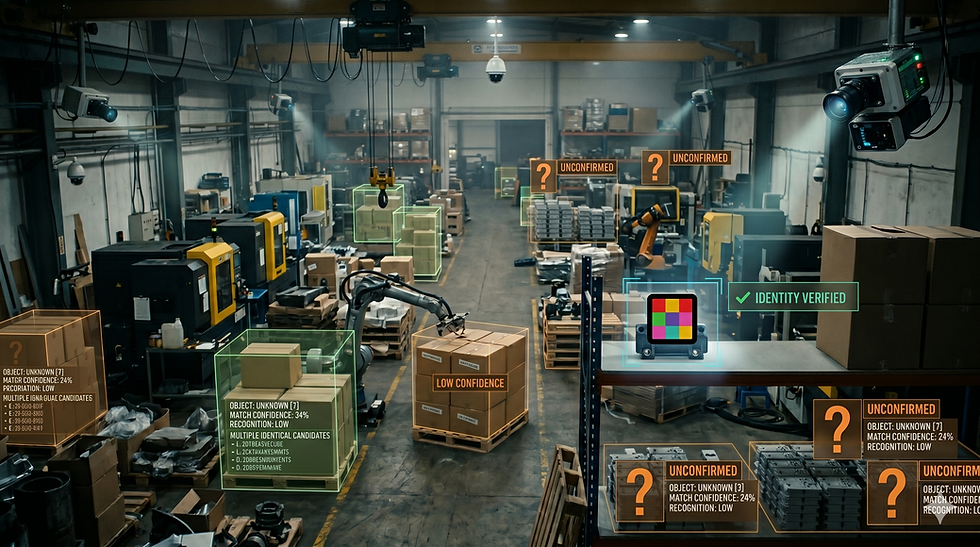
Objects move. Environments change. Assets may look identical. Labels can be copied. Visual conditions vary. Machines may detect that something is present without knowing which specific object it is.
That is why Physical AI depends on more than models or sensors.
It requires a stack.
This stack connects physical objects, machine vision systems, identity infrastructure, digital records, and automation platforms into a system that machines can use to interact with the real world reliably.
For a broader definition of the category, see What Is Physical AI.
What Is the Physical AI Stack?
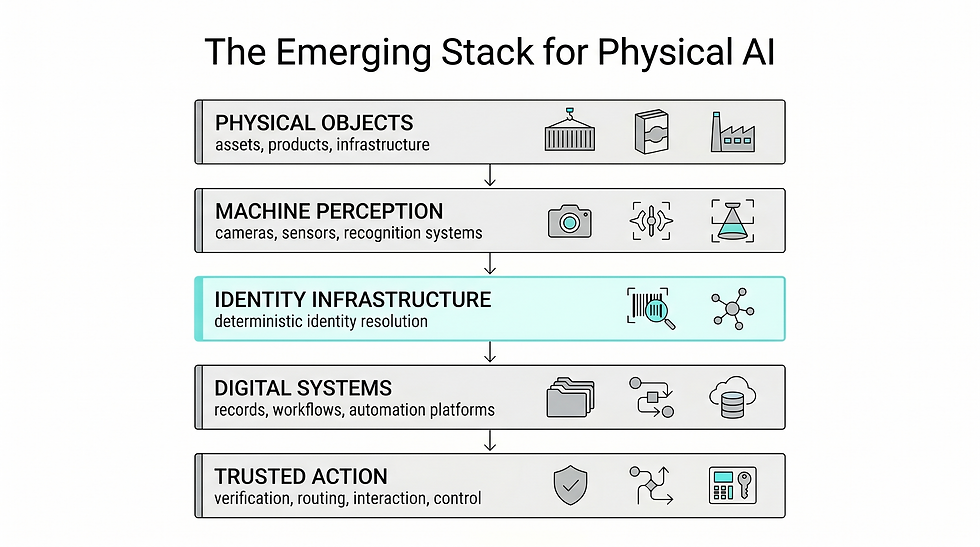
The Physical AI stack is the set of infrastructure layers that allow machines to perceive, identify, and interact with physical objects and environments.
At a high level, the stack includes:
Machine perception
Machine-readable identity
Identity resolution
System integration
Trusted action
Each layer performs a different function.
Machine perception allows systems to see.
Identity infrastructure allows systems to know what they are seeing.
System integration allows machines and software platforms to act on that information.
Without all three, Physical AI remains incomplete.
Why Physical AI Requires a Stack
Physical AI systems do not operate inside clean digital environments.
They operate in warehouses, factories, infrastructure sites, retail environments, logistics networks, roads, airspace, and other dynamic physical settings.
These environments introduce uncertainty.
Machines may need to determine:
What object is present
Which specific object it is
Whether the object is trusted
Which system record applies
What action should occur
Whether the action is permitted
No single technology layer solves all of this.
Computer vision can help machines detect and classify objects.
But perception alone does not always determine identity.
A database can store digital records.
But the system still needs a reliable way to connect a physical object to the right record.
Automation software can trigger workflows.
But those workflows depend on the system knowing which physical asset is involved.
The stack matters because each layer closes a different part of the gap between physical reality and digital action.
Layer 1: Physical Objects and Environments
The first layer of the Physical AI stack is the physical world itself.
This includes:
Products
Packages
Components
Vehicles
Infrastructure assets
Screens
Equipment
Physical spaces
These objects and environments are not inherently machine-readable.
A machine may see a package, but that does not mean it knows which package it is.
A robot may detect a component, but that does not mean it knows whether the component is approved, verified, or assigned to a specific workflow.
For Physical AI to operate reliably, physical objects must become addressable by machines.
That requires identity infrastructure.
Layer 2: Machine Perception
Machine perception allows systems to detect and interpret physical environments.
This layer may include:
Cameras
Sensors
Computer vision models
Object detection systems
Recognition systems
Edge processing
Machine perception gives machines awareness.
It helps systems determine that an object is present, where it is located, and what type of object it may be.
But awareness is not identity.
A vision system may determine that an object appears to be a box, a valve, a screen, or a pallet.
That does not mean it can determine which specific box, valve, screen, or pallet is present.
This is one of the central limitations of perception-only systems.
Layer 3: Machine-Readable Identity
The next layer is machine-readable identity.
This is where physical objects become distinguishable to machines.
Machine-readable identity allows systems to identify specific physical assets using signals that machines can detect and interpret.
This may involve machine-readable identity markers, structured visual identifiers, embedded identifiers, or other identity systems designed for automated interpretation.
The purpose is not simply to attach information to an object.
The purpose is to allow machines to resolve object identity.
That distinction matters.
A simple code may retrieve information.
Identity infrastructure determines which object is present and whether it is associated with a valid digital record.
This is the layer that helps move Physical AI from recognition to certainty.
Layer 4: Identity Resolution
Identity resolution connects a detected physical identifier to a digital identity.
This layer answers questions such as:
Which object is this?
Is this identifier valid?
Is the object trusted?
What system record does it belong to?
What permissions, history, or workflow apply?
Identity resolution is where the physical object becomes meaningful to digital systems.
Without identity resolution, a machine-readable marker remains only a signal.
With identity resolution, that signal becomes connected to a system of record.
This is what allows Physical AI systems to interact with real assets instead of abstract object categories.
For a deeper explanation of this layer, see The Identity Layer for the Physical World.
Layer 5: Digital Systems and System of Record
Once identity has been resolved, the system needs somewhere to connect that identity.
That is the role of digital systems and systems of record.
These may include:
Enterprise software
Logistics platforms
Authentication systems
Asset management databases
Industrial automation systems
Infrastructure monitoring platforms
Analytics systems
AI decision systems
The system of record provides context.
It defines what the object is, where it belongs, what history it carries, and what actions may be taken.
This layer turns identity into operational meaning.
A machine does not only detect an object.
It connects the object to the data and logic that determine what should happen next.
Layer 6: Automation and Trusted Action
The final layer is action.
Once a machine detects an object, resolves identity, and connects that identity to a digital system, it can trigger a trusted action.
Examples include:
Updating inventory
Confirming authenticity
Opening an access workflow
Triggering inspection
Recording an interaction
Routing an object
Initiating a service process
Delivering a digital experience
This is where Physical AI becomes operational.
The system moves from perception to identity to action.
The action is not based on visual guesswork.
It is based on resolved identity.
The Physical AI Stack in Practice
The stack can be understood as a sequence:
Physical object→ Machine perception→ Machine-readable identity→ Identity resolution→ System of record→ Trusted action
Each layer depends on the one before it.
If the system cannot perceive the object, it cannot identify it.
If it cannot identify the object, it cannot resolve identity.
If it cannot resolve identity, it cannot connect to the correct digital record.
If it cannot connect to the correct digital record, it cannot take reliable action.
This is why Physical AI must be built as infrastructure, not as a single application.

Why Identity Is the Critical Layer
Machine perception is important.
But identity is what gives Physical AI reliability.
Without identity, machines may see objects but remain uncertain about what those objects actually are.
This matters in environments where objects must be individually tracked, verified, authenticated, or acted upon.
Examples include:
A package moving through a logistics network
A product requiring authentication
A component entering an assembly process
A drone identifying a landing target
A screen triggering an interactive experience
An asset requiring inspection or service
In each case, the system needs to know which specific object is present.
Identity infrastructure creates that certainty.
Why the Stack Must Work Across Environments
Physical AI infrastructure must operate in real-world conditions.
That means the stack must work across:
Distance
Motion
Changing light
Different surfaces
Multiple objects
Operational noise
Limited connectivity
Complex environments
Controlled environments are easier.
Real infrastructure is not controlled.
For Physical AI to scale, the stack must be designed for physical reality.
That is why machine-readable environments, robust recognition systems, identity resolution, and operational integration all matter.
For more on this challenge, see Why the Physical World Is Not Yet Machine Readable.
The Emerging Infrastructure Opportunity
The Physical AI stack is still emerging.
Many systems today solve only part of the problem.
Computer vision companies provide perception.
Robotics companies provide motion and task execution.
Enterprise platforms provide workflows.
Authentication systems provide trust logic.
But these systems often lack a shared identity layer for the physical world.
That creates an infrastructure gap.
The next stage of Physical AI will require systems that connect machine perception with persistent physical identity and digital records.
This is where the infrastructure opportunity exists.
Not in another standalone app.
Not in another isolated model.
In the layer that allows physical objects to become reliably identifiable by machines and actionable by digital systems.
Key Takeaways
Physical AI requires a layered infrastructure stack.
Machine perception allows systems to detect physical objects, but perception alone does not resolve identity.
Machine-readable identity allows physical objects to become distinguishable to machines.
Identity resolution connects physical objects to digital records and systems of record.
Trusted action depends on resolved identity, not visual estimation alone.
The emerging Physical AI stack connects physical objects, machine vision, identity infrastructure, digital systems, and automation platforms.
Frequently Asked Questions About the Physical AI Stack
What is the Physical AI stack?
The Physical AI stack is the set of infrastructure layers that allow machines to perceive, identify, and interact with physical objects and environments.
Why does Physical AI need a stack?
Physical AI needs a stack because no single technology layer can fully solve perception, identity, system integration, and trusted action. Each layer performs a different role.
Is computer vision enough for Physical AI?
No. Computer vision can detect and classify objects, but it does not always determine the identity of a specific object. Physical AI also requires identity infrastructure and system integration.
What is the most important layer in the Physical AI stack?
Identity infrastructure is one of the most important layers because it allows machines to determine which specific object they are interacting with and connect that object to a digital record.
How does the Physical AI stack support automation?
The stack allows machines to detect objects, resolve identity, connect to systems of record, and trigger trusted actions within automation workflows.
Conclusion
Physical AI is not a single technology.
It is an infrastructure stack.
Machine perception allows systems to see the physical world.
Identity infrastructure allows systems to know what they are seeing.
Digital systems provide context.
Automation platforms enable action.
Together, these layers create the foundation for reliable machine interaction with physical environments.
As AI systems continue moving into the real world, the ability to connect physical objects with persistent digital identity will become increasingly important.
The emerging Physical AI stack is the infrastructure that makes that possible.
About Sodyo
Sodyo builds the infrastructure that gives physical objects persistent digital identity.
Its platform enables machines and digital systems to resolve identity from the physical world, supporting trusted interaction across engagement, authentication, logistics, and infrastructure environments.


Comments