
Why the Physical World Is Not Yet Machine Readable

Introduction
Digital systems are machine readable by design.
Files, users, devices, and applications possess identifiers that allow software systems to determine what something is, where it belongs, and what actions can occur.
The physical world operates differently.
Objects in real environments rarely possess persistent digital identities that machines can easily interpret. As a result, automation systems often rely on indirect signals, visual estimation, or contextual inference when interacting with physical assets.
This creates a structural problem for Physical AI.
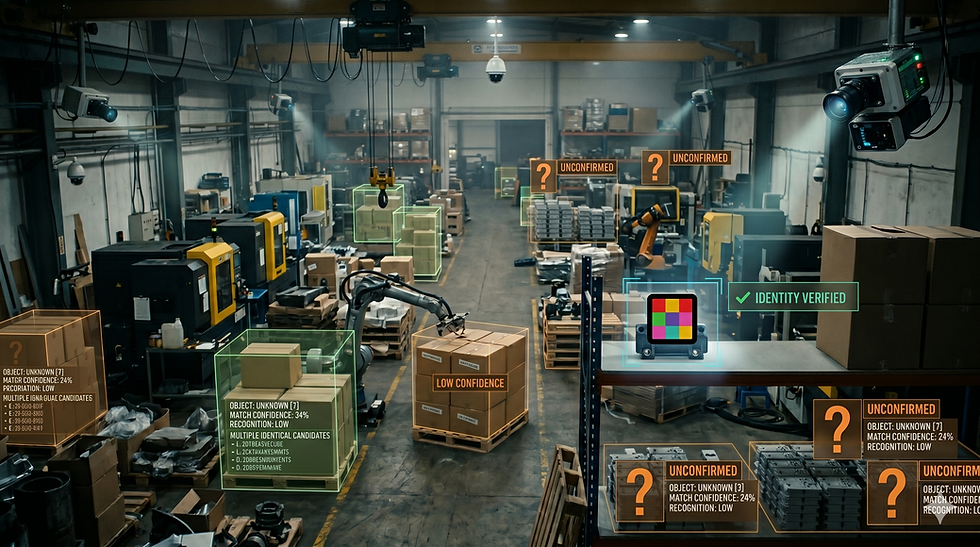
Machines can increasingly see the physical world. But in many environments, they still cannot reliably determine what they are seeing, which specific object is present, or what action should follow.
The physical world was not originally designed to be interpreted by machines.
For a broader definition of the category, see What Is Physical AI.
What Does Machine-Readable Mean?
A machine-readable environment is a physical environment structured so machines can detect objects, resolve identity, and connect what they observe to digital systems.
In digital systems, machine readability is created through identifiers such as IP addresses, device IDs, user accounts, and structured databases.
In physical environments, machine readability requires physical objects to carry or connect to identifiers that machines can detect and resolve.
Without this infrastructure, machines must rely on probabilistic perception instead of deterministic interpretation.
Why Digital Systems Are Machine Readable
Digital environments were designed around identity and structure.
Every object within a digital system possesses a unique identifier.
Examples include:
IP addresses used to identify devices on networks
User accounts used to authenticate individuals
Database keys used to track digital records
Device identifiers used in connected systems
These identifiers allow software systems to coordinate interactions between millions or billions of digital entities.
Without these identity systems, digital infrastructure would not function reliably.
Why the Physical World Is Different
Physical environments were not originally designed to be interpreted by machines.
Objects may have labels, serial numbers, or documentation, but these identifiers are often designed for human interpretation rather than machine perception.
In many environments:
Identifiers may not be visible to sensors
Labels may be duplicated or replaced
Multiple objects may appear visually identical
Information about objects may exist only in external databases
As a result, machines operating within physical environments often lack reliable mechanisms for determining object identity.
Why Perception Alone Is Not Enough
Computer vision systems allow machines to detect and classify objects within complex environments.
These technologies represent a major advancement in machine perception.
However, perception alone does not fully solve the problem of identity.
A vision system may determine that an object appears to be a package, a component, or a piece of equipment.
Determining which specific object it is requires additional infrastructure.
Without identity systems, machines often rely on probabilistic recognition rather than deterministic identification.
A machine-readable environment reduces that uncertainty by giving machines structured identity signals they can detect and resolve.
Why Machine Readability Matters
As automation systems scale, machines increasingly interact with large numbers of physical assets.
Examples include:
Packages moving through logistics networks
Components on manufacturing assembly lines
Infrastructure equipment deployed across large facilities
Devices operating within industrial environments
In these environments, machines frequently need to determine the identity of specific objects before performing actions.
This may include verifying an asset, retrieving digital information, or triggering operational workflows.
Without reliable identity systems, these processes become more difficult to automate.
The Infrastructure Required for Machine-Readable Environments
Machine-readable environments require more than sensors.
They depend on infrastructure that allows machines to detect physical objects, resolve identity, and connect those identities to operational systems.
Machine Perception Systems
Sensors and computer vision systems allow machines to detect and interpret objects within their environment.
These systems provide awareness of the physical world.
But awareness is not identity.
A machine may detect that an object is present without knowing which specific object it is.
Physical Identity Systems
Physical identity systems allow objects to possess machine-readable identifiers detectable by automated systems.
These identifiers help machines distinguish individual objects within physical environments.
They create the foundation for persistent physical-digital identity.
Identity Resolution Platforms
Identity resolution platforms connect detected identifiers with digital records associated with assets.
These platforms allow machines to retrieve information about objects once identity has been determined.
This is what allows a physical object to become actionable within a digital system.
Integration with Automation Systems
Identity systems become more powerful when connected with logistics platforms, industrial software systems, robotics platforms, or infrastructure monitoring tools.
This allows machines to trigger actions based on verified object identity.
Machine readability becomes valuable when it connects perception to action.
Building Machine-Readable Environments
Transforming physical environments into machine-readable systems requires infrastructure that allows machines to determine the identity of objects around them.
This infrastructure bridges the gap between physical assets and digital information systems.
When machines can detect identifiers, resolve identity, and retrieve associated digital data, automation systems can operate with greater reliability.
As robotics, AI, and automation systems continue to expand into real-world environments, machine-readable infrastructure may become an important foundation for these technologies.
Machine-Readable Environments and Physical AI
Physical AI systems depend on the ability to interpret and act within physical environments.
Perception systems help machines see.
Identity infrastructure helps machines understand which specific object they are seeing.
System integration allows machines to act on that information.
Together, these capabilities allow Physical AI systems to move from observation to reliable interaction.
Without machine-readable environments, Physical AI systems remain limited by uncertainty.
With machine-readable environments, machines can interact with physical assets using structured identity rather than visual estimation alone.
Key Takeaways
Digital systems rely on identity infrastructure to enable machine interpretation.
The physical world traditionally lacks machine-readable identity systems.
Computer vision provides awareness, but awareness is not identity.
Machine-readable environments require perception systems, identity infrastructure, and digital integration.
Infrastructure that enables machine-readable environments may become foundational for Physical AI.
Frequently Asked Questions About Machine-Readable Environments
What is a machine-readable environment?
A machine-readable environment is a physical environment structured so machines can detect objects, resolve identity, and connect what they observe to digital systems.
Why is the physical world not machine readable today?
Most physical environments were designed for human interpretation, not machine interpretation. Objects may have labels, serial numbers, or barcodes, but these do not always provide persistent machine-readable identity.
Is computer vision enough to make environments machine readable?
No. Computer vision can detect and classify objects, but it does not always determine the identity of a specific object. Machine-readable environments require identity infrastructure as well as perception.
Why do machine-readable environments matter for Physical AI?
Physical AI systems need reliable ways to determine what objects are, which specific object is present, and what action should occur. Machine-readable environments provide the infrastructure for that reliability.
Conclusion
Artificial intelligence has advanced rapidly in digital environments where data structures and identity systems already exist.
The physical world presents a different challenge.
Objects in real environments do not inherently possess digital identities that machines can easily interpret.
As AI systems expand into logistics networks, robotics platforms, infrastructure systems, and industrial automation environments, solving this challenge becomes increasingly important.
Creating machine-readable physical environments may therefore represent an important step toward enabling reliable interaction between machines and the physical world.
About Sodyo
Sodyo builds the infrastructure that gives physical objects persistent digital identity.
Its platform enables machines and digital systems to resolve identity from the physical world, supporting trusted interaction across engagement, authentication, logistics, and infrastructure environments.


Comments