
Why Identity Is the Defensible Layer of Physical AI

Introduction
The Physical AI conversation often starts with the visible layers.
Robots.
Drones.
Cameras.
Sensors.
Autonomous systems.
AI models.
These layers matter. They are where the action is easiest to see.
But the most defensible infrastructure in Physical AI may sit underneath them.
Identity.
Machines operating in the physical world need more than perception. They need to know which specific object, asset, location, surface, screen, package, component, or marker is present.
They need to connect what they see to trusted digital records.
They need to act on resolved identity, not visual estimation alone.
That makes identity a foundational layer of Physical AI.
Not because it is the most visible.
Because everything above it depends on it.

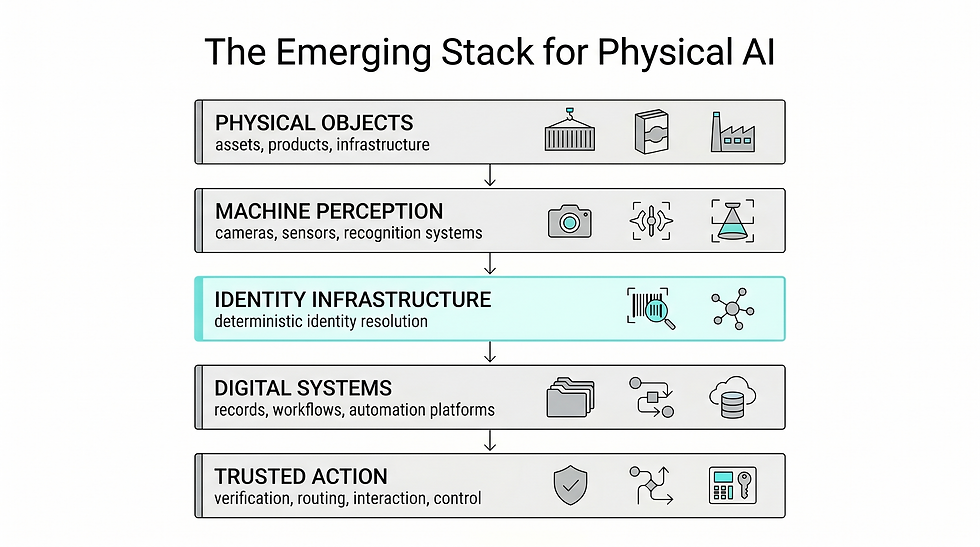
Physical AI Needs a Stack
Physical AI is not one technology.
It is a stack.
At a simple level, Physical AI systems need to do three things:
Perceive the physical world
Decide what should happen
Act in the physical world
That creates visible layers.
The perception layer includes cameras, sensors, machine vision, and environmental detection.
The decision layer includes AI models, reasoning systems, autonomy logic, and workflow intelligence.
The action layer includes robotics, drones, vehicles, automation systems, machines, and physical execution.
But there is a missing layer between perception and action.
Identity.
A machine may perceive an object.
A model may classify it.
A robot may be able to act on it.
But unless the system can determine which specific object is present, the action may still be based on uncertainty.
Physical AI needs identity infrastructure because the physical world is not just made of categories.
It is made of specific entities.
The Core Problem: Physical Objects Are Not Natively Digital
Digital systems are built around identity.
Users have IDs.
Devices have IDs.
Files have IDs.
Accounts have IDs.
Transactions have IDs.
APIs pass structured identifiers between systems.
This is what allows digital systems to connect data, permissions, history, state, and action.
The physical world does not work that way by default.
A package, product, component, sign, screen, asset, or location may exist physically, but it is not automatically machine-resolvable.
A camera may see it.
A model may recognize it.
A system may infer what it is.
But the physical object is not natively connected to a trusted digital identity.
That gap is the infrastructure opportunity.
Physical AI requires a way to give real-world objects persistent, machine-readable identity.
Without that layer, machines see physical objects but cannot reliably resolve them.
Why Perception Alone Is Not Defensible Enough
Perception is improving quickly.
Computer vision models can detect and classify more objects across more environments. Sensors are becoming cheaper. Cameras are everywhere. Edge processing is improving.
That progress is important.
But perception alone is not enough to create durable defensibility.
Perception answers questions like:
Is something present?
What type of object appears to be here?
Where is it located?
What pattern does this resemble?
What is the confidence score?
Those are useful questions.
But many Physical AI workflows require a more specific answer:
Which exact object is this?
That answer cannot always be solved by better recognition.
A model may become excellent at recognizing pallets and still not know which pallet is present.
It may recognize a product and still not know whether the specific unit is authentic.
It may detect a landing zone and still not confirm whether it is the correct one.
Perception creates awareness.
Identity creates operational certainty.
Why Identity Becomes Defensible
Identity infrastructure can become defensible because it sits at the control point between the physical world and digital action.
Once a system relies on identity to trigger workflows, that identity layer becomes difficult to replace.
It connects:
Physical objects
Machine-readable markers
Detection systems
Identity resolution logic
Systems of record
Verification rules
Workflow integrations
Vertical applications
That creates infrastructure value.
The more objects, environments, records, and workflows connect through the identity layer, the more strategically important the layer becomes.
This is different from a feature.
A feature can be copied.
A workflow can be replicated.
A visual interface can be redesigned.
But infrastructure that resolves physical identity across systems becomes embedded.
It becomes part of how physical operations connect to digital systems.
That is where defensibility can emerge.
Identity Is the Layer Others Build Around
In Physical AI, identity is not only a technical capability.
It is a coordination layer.
Different systems need a shared way to understand the same physical object.
A camera may detect it.
An AI model may reason about it.
A robot may act on it.
A logistics system may route it.
An authentication system may verify it.
An asset system may update its status.
A customer-facing application may trigger an interaction.
Each system may do something different.
But each depends on knowing which object is involved.
That makes identity the layer others build around.
It creates a stable reference point for multiple applications, workflows, and verticals.
This is why platform-level identity infrastructure can support different markets without becoming a single vertical application.
Sodyo is the platform layer.
Verimark applies that infrastructure to security and governance.
Qapture applies it to interactive engagement.
Zimark applies it to logistics and asset-level intelligence.
The verticals differ.
The identity requirement underneath them is common.
Why Deterministic Identity Matters
Physical AI cannot rely only on probabilities when the action depends on a specific object.
A probabilistic system may estimate that an object is likely to be a package, product, component, screen, vehicle, or asset.
That can support recognition.
But deterministic identity answers a different question:
Which specific object is present?
This matters when machines must:
Route a package
Authenticate a product
Approve a component
Update an asset record
Verify a location
Trigger an inspection
Confirm an interaction
Allow or deny a workflow
In these cases, a confidence score may not be enough.
The system needs resolved identity.
Deterministic identity creates the foundation for trusted action.
For investors and infrastructure partners, this distinction matters because it separates useful AI perception from operational AI infrastructure.
Why Identity Creates Ecosystem Leverage
Infrastructure becomes more valuable when multiple ecosystems can build on it.
Identity has that property.
A strong physical identity layer can support different applications without being limited to one use case.
The same underlying identity architecture can support:
Authentication
Logistics
Interactive engagement
Asset intelligence
Industrial automation
Machine-readable environments
Drone and robotic workflows
Smart infrastructure
Physical AI systems
Each use case may require different product packaging, sales motion, and workflow integration.
But the underlying problem is consistent:
How does a digital system know which physical object is present?
That consistency creates platform leverage.
The company that owns the identity layer can support many vertical expressions while maintaining a common infrastructure foundation.
The Investor View: Why This Layer Matters
From an investment perspective, Physical AI will create demand for many categories of infrastructure.
Models will improve.
Robotics platforms will mature.
Sensors will become cheaper.
Automation systems will expand.
But these layers still need trusted physical-digital identity.
The strategic question is:
What must exist before Physical AI can operate reliably at scale?
One answer is identity infrastructure.
Without it, machines may perceive environments but struggle to connect perception to trusted action.
With it, physical objects can become addressable, resolvable, and actionable within digital systems.
That is a meaningful infrastructure thesis.
Identity is not just a supporting feature.
It is a prerequisite for many downstream workflows.
The Buyer View: Why This Layer Matters
For buyers and partners, the issue is practical.
Industrial systems already face gaps between what machines can see and what systems can know.
A camera can see an object.
A model can classify it.
A worker can interpret the context.
But automated systems need something more structured.
They need identity that can be read, resolved, trusted, and connected to action.
This matters when buyers need:
Less manual intervention
Better workflow reliability
Reduced ambiguity
Stronger authentication
More scalable automation
Better asset-level visibility
More reliable machine-readable environments
Identity infrastructure gives buyers a way to move from visual observation to system-level certainty.
That is the operational value.
Why This Is Not Just Another Code
It is important not to reduce identity infrastructure to “a better code.”
That undersells the category.
A visual code, marker, or identifier may be part of the system.
But the defensible value is the infrastructure around it.
The marker enables detection.
The identity layer enables resolution.
The system of record provides context.
The workflow integration enables action.
The trust model determines whether the action should occur.
That full architecture is what matters.
A code can be copied.
A graphic can be imitated.
A scanning interface can be recreated.
But a trusted identity infrastructure layer, embedded across objects, systems, and workflows, is harder to displace.
The defensibility is not only in what is printed.
It is in what the printed identity connects to.
Why This Matters Now
Physical AI is moving from concept to deployment.
Machines are being asked to operate in warehouses, factories, infrastructure sites, logistics networks, retail environments, public spaces, screens, vehicles, and autonomous systems.
As that happens, the identity gap becomes more obvious.
Machines can detect more.
They can classify more.
They can reason more.
But they still need to know which physical entities they are acting on.
That is why identity infrastructure becomes more important as AI becomes more physical.
The more autonomy moves into real environments, the more identity matters.
Key Takeaways
Physical AI requires perception, decision-making, action, and identity.
Perception tells machines what appears to be present.
Identity tells machines which specific object is present.
Identity infrastructure connects physical objects to trusted digital records.
This layer can become defensible because it sits between physical detection and digital action.
Sodyo is a platform identity layer, not a single vertical application.
Verimark, Qapture, and Zimark are vertical expressions of the same underlying infrastructure.
The Physical AI investment thesis depends on infrastructure that makes physical objects addressable, resolvable, and actionable.
Frequently Asked Questions About Identity and Physical AI Defensibility
Why is identity important in Physical AI?
Identity is important because Physical AI systems need to determine which specific physical object, asset, location, or interaction is present before they can act reliably.
Is computer vision enough for Physical AI?
No. Computer vision supports perception and recognition, but Physical AI also needs identity infrastructure to connect physical objects to trusted digital records and workflows.
What makes identity infrastructure defensible?
Identity infrastructure becomes defensible when it is embedded across objects, systems of record, verification logic, and workflow integrations. It becomes a control point between physical reality and digital action.
How is identity different from recognition?
Recognition classifies what type of object appears to be present. Identity resolves which specific object is present and connects it to digital context.
Is Sodyo a vertical application?
No. Sodyo is the platform layer. Verimark, Qapture, and Zimark are vertical applications built on Sodyo’s physical identity infrastructure.
Conclusion
Physical AI will not be defined only by better models, better sensors, or more capable robots.
Those layers matter.
But they still need a trusted way to connect physical reality to digital systems.
That is the role of identity infrastructure.
Identity allows machines to determine which specific object is present, connect that object to a digital record, and trigger the right action.
It is the layer between seeing and doing.
That is why identity may become one of the most defensible layers of the Physical AI stack.
The future of Physical AI depends on machines that can do more than recognize the world.
They need to resolve it.
About Sodyo
Sodyo builds the infrastructure that gives physical objects persistent digital identity.
Its platform enables machines and digital systems to resolve identity from the physical world, supporting trusted interaction across engagement, authentication, logistics, and infrastructure environments.
Sodyo is the platform layer behind vertical applications including Verimark, Qapture, and Zimark.

Comments