
Why AI Systems Need Deterministic Identity

Introduction
Artificial intelligence systems are becoming increasingly capable at recognizing patterns, detecting objects, and interpreting complex environments.
Computer vision systems can identify packages, components, people, vehicles, equipment, and infrastructure assets with impressive accuracy.
But recognition is not identity.
A machine may detect that an object appears to be a package.
It may classify an object as a component.
It may recognize that a piece of equipment belongs to a certain category.
But in many operational environments, that is not enough.
The system needs to determine which specific package, component, or asset is present.
That requirement creates the need for deterministic identity.

What Is Deterministic Identity?
Deterministic identity refers to the ability of a system to determine the specific identity of an object with a defined, reliable result.
In the physical world, this means a machine can determine not only that an object appears to be a package, product, component, or asset, but which exact object it is.
For example:
Package 94831
Component A-203
Asset ID 002781
Product Unit 59402
Infrastructure Node 17
Deterministic identity answers the question:
Which object is this?
That is different from recognition, which answers:
What type of object is this?
Physical AI systems often require both.
Recognition provides awareness.
Identity provides certainty.
Why Probabilistic Recognition Is Not Enough
Many AI systems rely on probabilistic recognition.
A model analyzes visual input and estimates what it is seeing based on patterns in training data.
This is useful for many tasks.
A vision model may determine that an object is likely a box, a bottle, a label, a valve, or a vehicle.
But probability does not always support operational trust.
In controlled environments, probability may be sufficient.
In real-world systems, uncertainty creates risk.
If a machine must inspect, route, authenticate, approve, reject, service, or interact with a specific physical object, it needs more than a likely classification.
It needs identity.
Without deterministic identity, machines may act on assumptions rather than verified object identity.
Recognition vs Deterministic Identity
Recognition and deterministic identity solve different problems.
Recognition classifies what something appears to be.
Deterministic identity resolves which specific object is present.
A warehouse system may recognize that an object is a package.
A deterministic identity system determines that it is Package 94831, linked to a specific shipment, status, destination, and system record.
A manufacturing system may recognize that an object is a component.
A deterministic identity system determines that it is Component A-203, approved for a specific assembly workflow.
A security system may recognize that an item appears to be a product.
A deterministic identity system determines whether that specific product is authentic, trusted, and associated with a valid digital record.
Why Deterministic Identity Matters for Physical AI
Physical AI systems operate in real-world environments.
These environments contain ambiguity.
Objects may look identical.
Labels may be damaged.
Lighting may change.
Objects may move.
Multiple assets may appear in the same visual field.
Context may be incomplete.
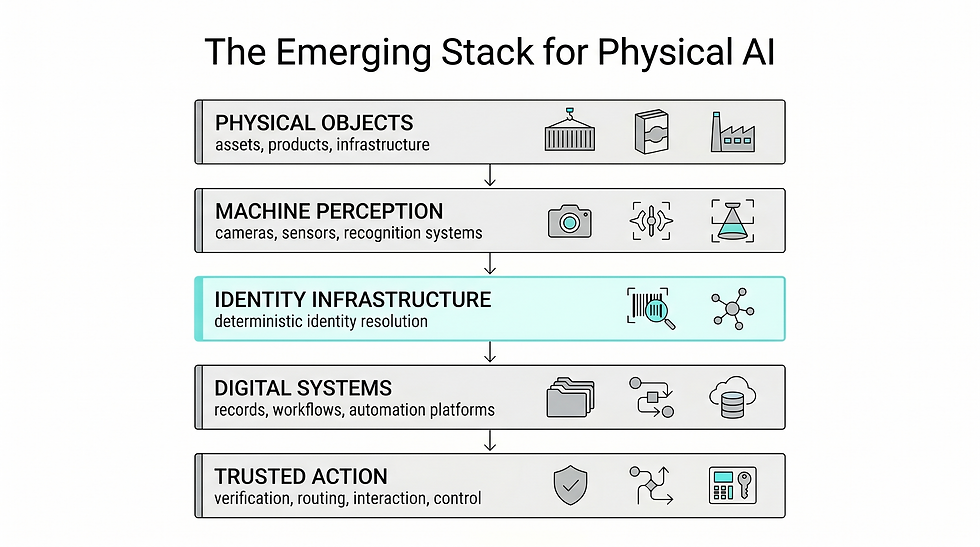
In these environments, machines need a reliable way to move from perception to identity.
Deterministic identity allows Physical AI systems to:
Identify specific physical objects
Connect objects to digital records
Verify trust or authenticity
Trigger the correct workflow
Reduce uncertainty in automated decisions
Support reliable interaction across environments
This is why deterministic identity is not a minor technical feature.
It is a foundational requirement for Physical AI infrastructure.
The Risk of Acting Without Identity
When AI systems act without deterministic identity, they may operate on incomplete information.
This creates operational risk.
Examples include:
A logistics system routing the wrong package
A robot handling the wrong component
An authentication system accepting a copied identifier
An inspection system associating results with the wrong asset
An automation platform triggering the wrong workflow
In each case, the machine may have recognized the object category correctly.
But the system still failed because it did not resolve the identity of the specific object.
The problem is not perception failure.
The problem is identity failure.
Deterministic Identity and Systems of Record
Deterministic identity becomes valuable when it connects the physical world to digital systems.
A physical object must map to a trusted digital record.
That record may contain:
Ownership
Authentication status
Location
History
Permissions
Workflow state
Inspection records
Operational instructions
Identity resolution connects what the machine sees to what the system knows.
Without this connection, a physical object remains disconnected from digital logic.
With deterministic identity, the object becomes actionable.
This is the bridge between physical assets and software systems.
For more on this infrastructure layer, see The Identity Layer for the Physical World.
Deterministic Identity vs Simple Identifiers
Not every identifier provides deterministic identity.
A barcode, QR code, serial number, or label can point to information.
But pointing to information is not the same as establishing trusted identity.
If an identifier can be copied, duplicated, replaced, or misapplied without detection, the system may not know whether it is interacting with the original object or a copy.
For simple information retrieval, this may not matter.
For automation, authentication, logistics, infrastructure management, or security, it matters significantly.
A copied identifier can create a false valid object within the system.
That breaks identity.
Deterministic identity requires infrastructure that helps machines determine whether the object being observed is associated with a valid and trusted digital identity.
The Infrastructure Required for Deterministic Identity
Deterministic identity depends on multiple infrastructure layers working together.
These may include:
Machine-Readable Identity Markers
Physical identifiers designed to be detected by machine vision systems or other automated systems.
Recognition Systems
Systems that detect and interpret identity signals in real-world environments.
Identity Resolution Platforms
Software systems that connect detected identifiers to digital records.
Verification Mechanisms
Systems that help determine whether an identifier is valid, trusted, or duplicated.
Integration with Operational Systems
Connections to software platforms that use identity to trigger action.
Together, these layers allow machines to resolve identity in the physical world.

Deterministic Identity Enables Trusted Action
Physical AI becomes useful when machines can act reliably.
Action may include:
Routing an asset
Authenticating a product
Updating a system record
Triggering a maintenance workflow
Confirming an inspection
Enabling access
Delivering a digital interaction
Each action depends on identity.
A machine should not trigger a workflow based only on a visual guess.
It should act based on resolved identity.
Deterministic identity creates the foundation for trusted action.
Why This Matters Now
The need for deterministic identity is becoming more urgent because AI systems are moving into physical environments.
Robotics, logistics automation, industrial inspection, smart infrastructure, authentication systems, and autonomous platforms all require machines to interact with real assets.
These systems cannot rely only on probabilistic recognition.
They need infrastructure that allows them to determine exactly which object is present and what action should occur.
As Physical AI expands, deterministic identity will become one of the core requirements for reliable machine interaction with the physical world.
Key Takeaways
Recognition and identity are different technical capabilities.
Recognition tells machines what type of object appears to be present.
Deterministic identity tells machines which specific object is present.
Physical AI systems require deterministic identity to connect physical assets to digital records.
Acting without identity creates operational risk.
Deterministic identity enables trusted action across automation, authentication, logistics, and infrastructure systems.
Frequently Asked Questions About Deterministic Identity
What is deterministic identity?
Deterministic identity is the ability of a system to determine the specific identity of an object with a reliable and defined result.
How is deterministic identity different from recognition?
Recognition identifies the type or category of an object. Deterministic identity identifies the specific object.
Why do AI systems need deterministic identity?
AI systems need deterministic identity because many physical-world tasks require machines to know exactly which object they are interacting with before taking action.
Is computer vision enough for deterministic identity?
No. Computer vision can detect and classify objects, but deterministic identity requires infrastructure that connects physical objects to trusted digital records.
Why does deterministic identity matter for Physical AI?
Physical AI systems operate in real environments where machines must identify, verify, and act on specific physical assets. Deterministic identity provides the reliability required for those actions.
Conclusion
AI systems can increasingly recognize the physical world.
But recognition alone is not enough.
Machines operating in real environments need to determine which specific object is present, whether it is trusted, what digital record applies, and what action should occur.
That requires deterministic identity.
Deterministic identity is the infrastructure that allows Physical AI systems to move from perception to certainty.
Without it, automation remains dependent on visual estimation.
With it, machines can interact with physical objects as trusted entities connected to digital systems.
About Sodyo
Sodyo builds the infrastructure that gives physical objects persistent digital identity.
Its platform enables machines and digital systems to resolve identity from the physical world, supporting trusted interaction across engagement, authentication, logistics, and infrastructure environments.


Comments