
How Physical Assets Become Digital Entities

A brand can hold a record for every serialized product. A campaign platform can maintain content for every marked advertisement. A drone operator can register each landing target. None of those records, by itself, tells a camera which entity it is looking at. A physical-digital identity connects the observation to the right record.
A physical asset becomes a digital entity when a machine-observable identity is assigned to it, resolved to a persistent digital record, and governed across its lifecycle. The identity is the stable reference; attributes such as location, status, owner, and instructions can change.
Five stages of a physical-digital identity
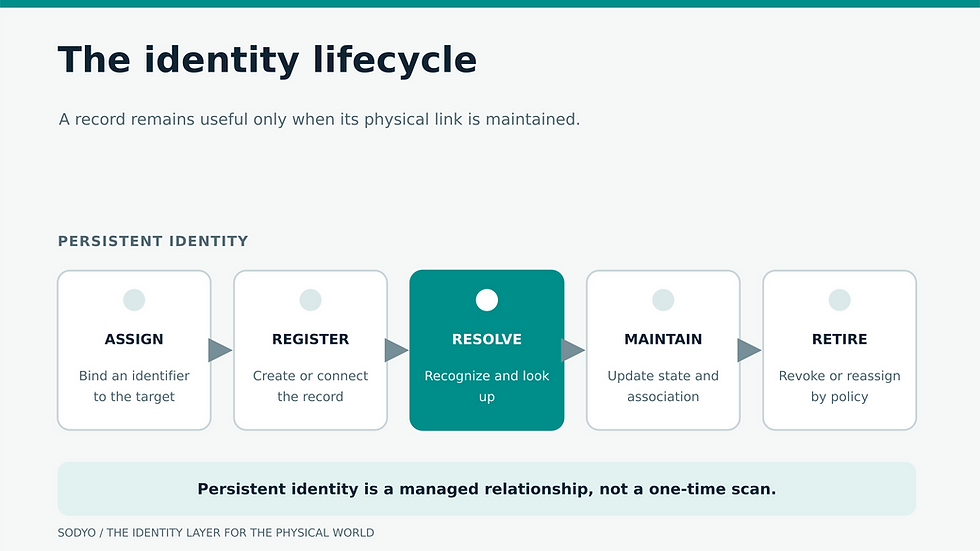
Assign. Decide what the identifier represents: a particular product, an engagement touchpoint, or a designated landing target. A Qapture campaign marker might identify content shared across several placements; a Verimark product identity may need to distinguish individual items. The identity scheme must reflect the precision the application actually needs.
Register. Bind the identifier to a digital record and define the authoritative system. Record the association, its owner, and the rules for changes. Without a governed binding, a readable marker can point to the wrong thing.
Resolve. A camera observes the marker, recognition software reads its identifier, and the identity service maps it to the record. The process should return either the intended identity or a defined exception. The Architecture of Physical-Digital Identity Systems examines each component of this handoff.
Maintain. Update the entity's changing attributes without losing its identity. A marked outdoor touchpoint can lead to updated campaign content. A product record can change status during its lifecycle. A landing-target record can be updated as operating availability changes. If the marker is damaged or replaced, its association needs a controlled update.
Retire or reassign. Define what happens when the asset is decommissioned, sold, destroyed, or reused. Old identifiers should not continue to resolve as though nothing changed. Reassignment, if allowed, must be explicit and auditable.
The same lifecycle, different applications
With Qapture, the maintained entity can be a broadcast or outdoor engagement touchpoint whose digital experience changes while its identity remains stable. Persistence here means continuity of the touchpoint and its record, rather than a permanent identity for every video frame.
With Verimark, the entity can be a particular marked product whose record supports authentication and status checks. With RangeMark, it can be a designated landing target that must retain its identity across approach observations and reacquisition. The lifecycle is shared; the meaning of the record depends on the application.
Identity is not the same as a digital twin
A digital twin may model state, behavior, or performance. Identity answers the more basic question of which physical entity that model or record represents. A sophisticated digital model is still vulnerable to a bad physical association. Conversely, a persistent identity can be useful without a full digital twin.
This is an architectural distinction, not a claim that every object needs a marker. Some environments can rely on other identifiers or controlled context. A dedicated visual identity layer becomes relevant when the system must distinguish specific targets through cameras in the operating conditions it faces.
Why persistence matters across systems
A one-off interaction can retrieve a web page. A persistent identity can connect repeated observations to the same entity, allowing applications to interpret its current state. That continuity supports workflows such as inspection, routing, maintenance, and controlled interaction. The application still decides what to do; identity gives it a stable reference.
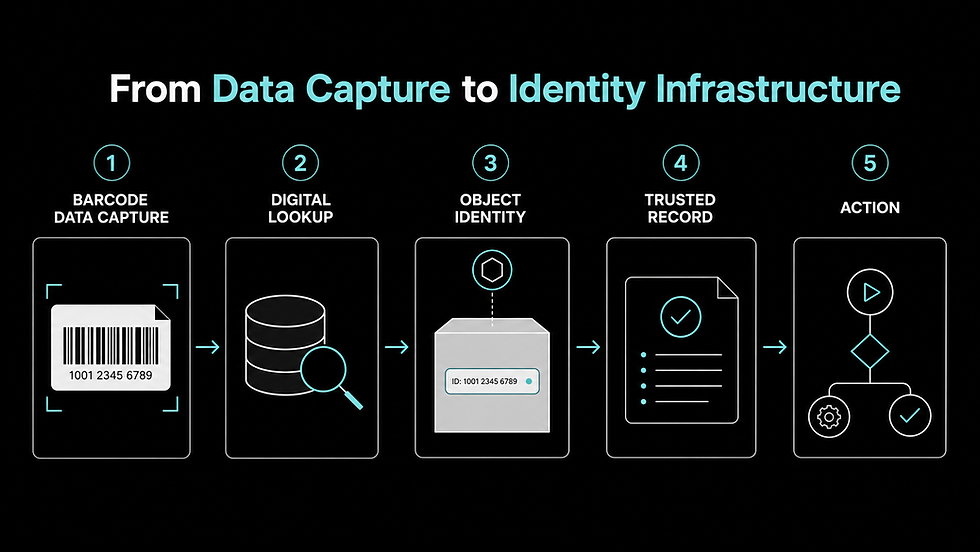
Traditional barcodes and QR codes can be effective identifiers when their operating conditions and security properties suit the task. The architectural evolution described in From Barcodes to Physical Identity Infrastructure is about extending identity into more demanding environments and governance requirements, not declaring those established formats obsolete.
Sodyo's platform role
Sodyo builds the infrastructure that gives physical objects persistent digital identity. Its visual marker, recognition, and resolution components help connect a camera observation with a specific entity. Qapture applies that foundation to engagement touchpoints, Verimark to product authentication and governance, and RangeMark to autonomous target identity. Sodyo provides the underlying identity layer, while each vertical owns its domain workflow.
The key deployment question is therefore not merely whether a marker can be read. It is whether the physical-to-digital association remains correct as objects move, records change, and observations repeat. The Identity Layer for the Physical World sets out the underlying infrastructure case.
A digital entity is only as dependable as the managed link to its physical counterpart. Talk to Sodyo about how that link would be assigned, resolved, and maintained in your system.


Comments