
Recognition vs Identity in Physical Systems

Introduction
Machines are getting better at recognizing the physical world.
Computer vision systems can detect objects, classify images, interpret scenes, and identify patterns. A system can recognize a package, product, vehicle, screen, component, sign, or person with increasing accuracy.
That progress matters.
But recognition is not the same as identity.
Recognition tells a system what type of object appears to be present.
Identity tells a system which specific object is present.
That distinction is not semantic. It is operational.
A machine that recognizes a package may still not know which package it is. A camera that detects a product may still not know whether that product is authentic. A drone that sees a landing zone may still not know whether it is the correct landing zone.
For physical systems, the difference between recognition and identity determines whether machines can move from perception to trusted action.

What Recognition Means
Recognition is the ability to classify what something appears to be.
In physical systems, recognition may involve cameras, sensors, computer vision models, AI classifiers, or pattern detection systems.
Recognition can answer questions such as:
Is there an object present?
What category does this object belong to?
Is this a package, pallet, product, screen, vehicle, or component?
Does this image match a known class?
Does this scene contain something unusual?
Recognition is valuable because physical environments are complex. Machines need ways to detect and classify what they see.
For example:
A warehouse system may recognize a box.
A factory camera may recognize a component.
A retail system may recognize a product shelf.
A drone may recognize a landing zone.
A security system may recognize a restricted area marker.
These are useful capabilities.
But recognition usually operates at the category level.
It tells the system what kind of thing appears to be present.
It does not necessarily tell the system which exact thing is present.
What Identity Means
Identity is the ability to determine which specific physical object is present.
Identity goes beyond classification.
It connects a physical object to a specific digital record, status, permission, history, or workflow.
Identity answers questions such as:
Which package is this?
Which product unit is this?
Which component is this?
Which asset is this?
Which location is this?
Which digital record applies?
Is this object trusted?
What action should occur?
For example:
Not just a package, but Package 94831.
Not just a component, but Component A-203.
Not just a product, but Product Unit 59402.
Not just an asset, but Infrastructure Node 17.
Not just a landing zone, but Landing Zone B-12.
Identity makes the object actionable.
Once a system resolves identity, it can connect the physical object to digital logic.
That is what allows machines to route, verify, authenticate, update, approve, deny, flag, or trigger workflows.
Why the Difference Matters
The difference between recognition and identity matters because physical systems do not only need to observe the world.
They need to act in it.
Action requires a higher level of certainty.
If a system only recognizes object categories, it may not know what record applies or what decision should follow.
A camera may recognize three identical packages. But if the system cannot determine which package is which, it cannot reliably route them.
A model may recognize a luxury product. But if the system cannot determine whether the specific unit is legitimate, it cannot authenticate it.
A drone may recognize a landing marker. But if it cannot confirm which marker it is, the operation may remain uncertain.
A factory system may recognize a component. But if it cannot confirm the exact component identity, it may not know whether that part belongs in the current assembly process.
Recognition supports awareness.
Identity supports action.
Recognition Can Be Probabilistic
Recognition is often probabilistic.
A model analyzes visual input and assigns confidence scores.
For example:
91 percent likely to be a package
84 percent likely to be a vehicle
76 percent likely to be a product label
68 percent likely to be a component
This is useful for many tasks.
Probabilistic recognition helps machines interpret complex scenes, detect anomalies, classify object types, and support human review.
But a probability score is not the same as object identity.
A system may be highly confident that it sees a package and still not know which package it sees.
This is why probabilistic recognition and deterministic identity play different roles.
Recognition helps machines interpret.
Identity helps machines resolve.
Identity Must Be Resolved
Identity is not simply “better recognition.”
That is the trap.
Improving a model’s recognition accuracy does not automatically create identity.
A system can become excellent at recognizing pallets and still not know which pallet is present.
It can recognize a product category and still not know whether the specific product is authentic.
It can detect a label and still not know whether the label belongs to that physical object.
Identity requires resolution.
That means the system must connect a physical signal to a specific digital record.
This may involve machine-readable identifiers, visual identity markers, verification logic, systems of record, and workflow rules.
The goal is not only to see the object.
The goal is to resolve the object.
Why Physical Systems Need Identity
Physical systems operate in real environments where objects have consequences.
A digital ad impression, a database query, or a software click may be reversible.
A physical action may not be.
Routing the wrong package, approving the wrong component, authenticating a copied product, opening the wrong access flow, or updating the wrong asset record can create operational, financial, security, or safety risk.
That is why identity matters.
Machines need to know not only what they are seeing, but which object they are interacting with.
This matters in environments such as:
Logistics
Manufacturing
Authentication
Industrial inspection
Infrastructure management
Asset tracking
Retail operations
Security and governance
Drone and autonomous systems
Screen-based engagement environments
Across these environments, the common requirement is object-level certainty.
That is what identity provides.
Recognition Without Identity Creates Risk
Recognition without identity can create false confidence.
A system may appear intelligent because it correctly classifies objects.
But if it cannot resolve specific identity, it may still act on incomplete information.
For example:
It recognizes a package but updates the wrong shipment record.
It recognizes a product but cannot detect that the identifier was copied.
It recognizes a component but cannot confirm that it belongs in the workflow.
It recognizes a location marker but cannot verify that it is the correct one.
It recognizes a screen or sign but cannot connect it to the intended digital interaction.
The system may be visually correct and operationally wrong.
That is the danger.
Recognition can tell the system what something resembles.
Identity tells the system what it is.
Identity Infrastructure Solves a Different Problem
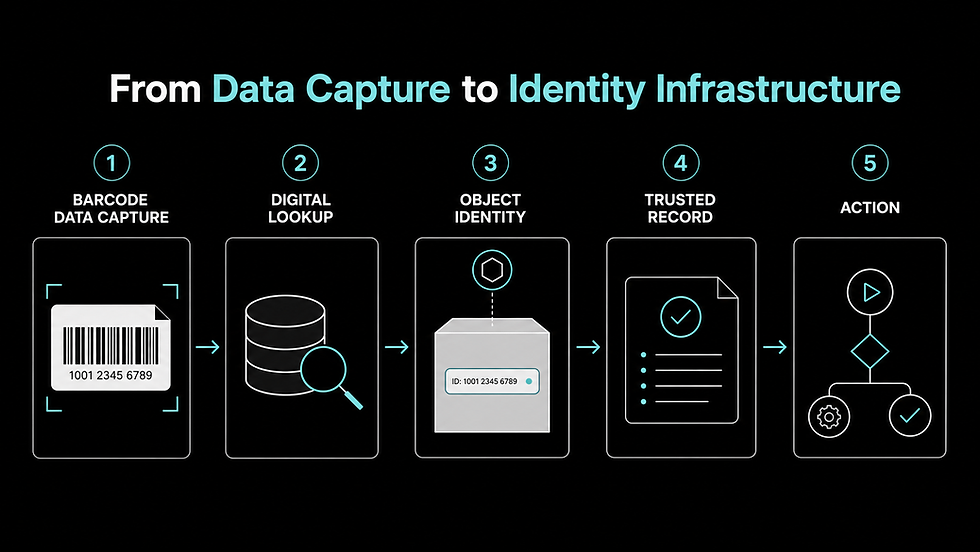
Identity infrastructure is the layer that allows machines to resolve specific physical objects.
It is not limited to a printed marker or code.
It includes the broader system required to connect physical presence to digital trust.
That can include:
Machine-readable visual identifiers
Detection systems
Identity resolution logic
Verification mechanisms
Systems of record
Context rules
Workflow integrations
Together, these components allow a system to answer:
Which object is present?
Is the object valid?
Is the identifier trusted?
What record applies?
What state is the object in?
What action is allowed?
This is the infrastructure that turns physical objects into trusted digital entities.
Why This Matters for Physical AI
Physical AI systems need to perceive, reason, and act in physical environments.
Recognition supports perception.
Identity supports trusted action.
A Physical AI system may use recognition to detect that an object is present and classify its type. But before it acts, it may need identity resolution to determine which specific object is present and what digital context applies.
That sequence matters:
Perceive the environment
Recognize the object type
Resolve object identity
Connect to digital context
Trigger action
Without identity, Physical AI remains dependent on visual estimation.
With identity, machines can connect physical objects to trusted digital systems.
That is what allows automation to move from seeing to knowing.
Recognition and Identity Work Together
Recognition and identity are not competitors.
They are complementary.
Recognition helps a system interpret the environment.
Identity helps the system resolve the specific object and act correctly.
In many workflows, both are needed.
Recognition may detect that an object exists and determine where it is in the scene.
Identity infrastructure may then resolve which object it is and connect it to the right record.
The problem comes when recognition is treated as enough.
For low-risk, category-level tasks, recognition may be sufficient.
For workflows involving trust, automation, authentication, routing, system updates, or physical action, identity is usually required.
The sharper question is not whether recognition works.
The question is whether recognition alone is enough for the action being taken.
From Recognition to Trusted Action
Trusted action depends on resolved identity.
A machine should not trigger a workflow based only on a visual guess when the outcome depends on a specific object.
It should act based on resolved identity.
Examples include:
Route this package
Authenticate this product
Approve this component
Update this asset record
Confirm this inspection point
Verify this location
Deliver this digital interaction
Flag this object for review
In each case, the action depends on knowing which physical object is present.
That is why identity becomes the foundation for machine-readable environments.
Key Takeaways
Recognition and identity are different capabilities.
Recognition tells a machine what type of object appears to be present.
Identity tells a machine which specific object is present.
Recognition is often probabilistic.
Identity requires resolution to a trusted digital record.
Physical systems need identity when workflows depend on object-level certainty.
Physical AI requires identity infrastructure to move from perception to trusted action.
Frequently Asked Questions About Recognition vs Identity
What is the difference between recognition and identity?
Recognition classifies what type of object appears to be present. Identity determines which specific physical object is present and connects it to a digital record.
Is object recognition enough for industrial automation?
Object recognition may be enough for some category-level tasks, but industrial automation often requires identity resolution before action can occur.
Why is recognition often probabilistic?
Recognition systems often rely on models that estimate the likelihood that an object belongs to a certain category. These confidence scores are useful, but they do not necessarily resolve specific identity.
What is identity resolution?
Identity resolution is the process of connecting a physical object or identity signal to a specific digital record, status, permission, or workflow.
Why does Physical AI need deterministic identity?
Physical AI systems need deterministic identity because machines must often know exactly which object they are interacting with before they can trigger reliable action.
Conclusion
Recognition and identity are both important, but they are not the same.
Recognition allows machines to classify the physical world.
Identity allows machines to resolve specific physical objects and connect them to trusted digital systems.
That difference becomes critical when machines are expected to act.
A system that recognizes an object may still be uncertain.
A system that resolves identity can connect physical reality to digital logic.
As Physical AI, industrial automation, and machine-readable environments expand, this distinction will become more important.
The future of physical systems will not depend only on machines that can see.
It will depend on machines that can know exactly what they are seeing.
About Sodyo
Sodyo builds the infrastructure that gives physical objects persistent digital identity.
Its platform enables machines and digital systems to resolve identity from the physical world, supporting trusted interaction across engagement, authentication, logistics, and infrastructure environments.
Sodyo is the platform layer behind vertical applications including Verimark, Qapture, and Zimark.


Comments