
From Barcodes to Physical Identity Infrastructure

Introduction
Barcodes were one of the most important machine-readable inventions of the last century.
They gave physical objects a simple way to connect to digital systems. A scanner could read a printed pattern and retrieve information from a database. Retail, logistics, manufacturing, healthcare, and supply chains all became more efficient because physical objects could be read by machines.
That was a major step forward.
But the role of machine-readable identity is changing.
Industrial systems, automation platforms, AI-enabled workflows, and Physical AI environments now require more than close-range data capture. They need to determine which specific object is present, whether it is trusted, what digital record applies, and what action should follow.
That is not just a barcode problem.
It is an infrastructure problem.
Barcodes helped digitize physical operations.
The next requirement is physical identity infrastructure.
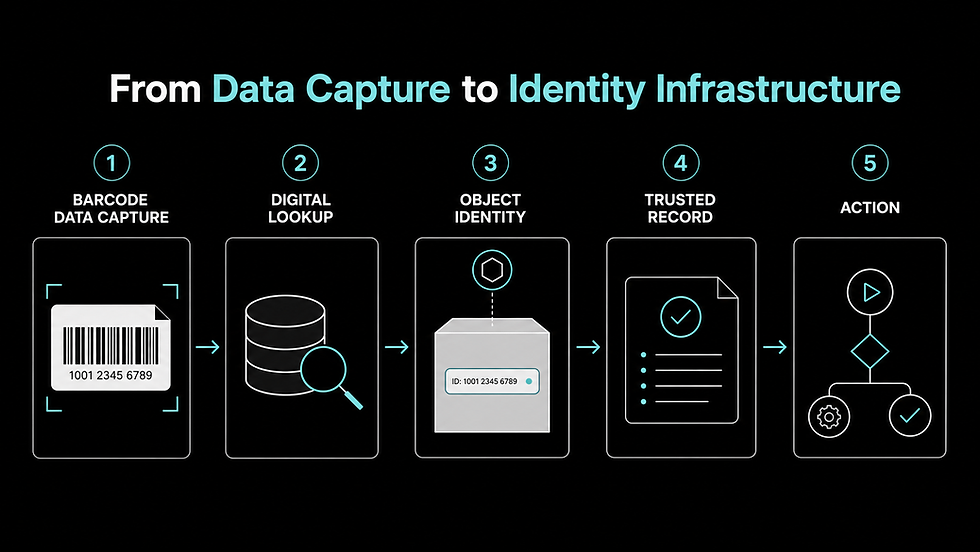
What Barcodes Made Possible
Barcodes solved a specific and important problem.
They made it possible for machines to read printed information quickly and consistently.
Instead of typing a product number, shipment code, or item identifier manually, a worker could scan a printed symbol. The system could then retrieve a record, update inventory, route an item, or process a transaction.
This changed entire industries.
Barcodes made operations faster, cheaper, and more structured. They reduced manual input. They standardized identification across retail and supply chains. They created a practical bridge between physical objects and digital databases.
That foundation still matters.
Barcodes remain useful when:
The scanner is close to the code
The code is visible and undamaged
The workflow is human-assisted
The environment is controlled enough for reliable scanning
The encoded data is enough to support the action
The risk of ambiguity is manageable
For many workflows, that is still sufficient.
But barcodes were designed for a different operating model than the one now emerging.
The Structural Limitation of Barcodes
The core limitation of barcodes is not that they are old.
The limitation is architectural.
A barcode is a printed data carrier. It represents information in a format that a scanner can read.
That is useful, but it is not the same as identity infrastructure.
A barcode can help a system retrieve data. But by itself, it does not necessarily establish whether the physical object is authentic, whether the identifier has been copied, whether the object is in the right place, whether the scan context is valid, or whether the system should trust the resulting action.
This distinction matters.
A barcode may tell a system what value was printed.
It does not automatically prove what physical object is present.
That creates risk when workflows depend on object-level certainty.
Data Capture Is Not the Same as Identity
Barcodes are often treated as identity systems because they appear on physical objects.
But there is a difference between data capture and identity.
Data capture answers:
What value did the scanner read?
Identity answers:
Which specific physical object is present?
Those are not the same question.
A barcode can encode or reference an item number, shipment number, serial number, batch number, URL, or database key. But the system still needs to determine whether the physical object carrying that code is the correct object.
For low-risk workflows, this may not matter.
For higher-value workflows, it matters a lot.
Examples include:
Authenticating a product
Routing a high-value asset
Confirming a component before assembly
Updating a regulated record
Verifying an infrastructure asset
Triggering an automated workflow
Allowing a machine to act without human review
In these cases, reading data is not enough.
The system needs resolved identity.
Why Physical Identity Infrastructure Is Different
Physical identity infrastructure is the layer that allows machines and digital systems to resolve specific physical objects.
It is not only a printed code.
It includes the full system required to connect physical presence to digital trust.
That may include:
Machine-readable markers or identifiers
Detection systems
Identity resolution logic
Verification mechanisms
Systems of record
Workflow integrations
Rules for trusted action
The goal is not simply to make an object readable.
The goal is to make the object identifiable, resolvable, and actionable by machines.
Physical identity infrastructure answers questions such as:
Which object is this?
Is this object valid?
Is this identifier trusted?
What record applies?
What state is the object in?
What action should occur?
Should the system allow, deny, flag, route, update, or trigger something?
That is a broader role than barcode scanning.
It is infrastructure for trusted physical-digital interaction.
Why This Shift Is Happening Now
The shift from barcode-based workflows to physical identity infrastructure is happening because machines are taking on more responsibility in physical environments.
Industrial systems are becoming more automated.
AI systems are moving from digital analysis into physical operations.
Cameras, sensors, drones, robots, and machine vision systems are being used to detect, inspect, route, authenticate, and act on physical assets.
That changes the requirement.
A human worker can often compensate for weak identity infrastructure. They can move closer, inspect the label, compare context, rescan, ask a supervisor, or use judgment.
A machine needs a more structured system.
It needs to detect the object, resolve identity, connect to a trusted record, and know what action is permitted.
This is why barcode limitations become more visible as automation increases.
The issue is not that barcodes stop working.
The issue is that the operating environment requires more than they were designed to provide.
The Physical AI Requirement
Physical AI depends on machines that can perceive, reason, and act in the physical world.
But perception alone is not enough.
A machine may see a package, product, asset, screen, component, or location. It may classify the object correctly. It may even assign a high confidence score.
But if the system cannot determine which specific object is present, it cannot reliably connect that object to digital logic.
That creates a gap between seeing and acting.
Physical identity infrastructure closes that gap.
It allows machines to move from:
Detection to identity
Recognition to resolution
Visual input to digital context
Digital context to trusted action
This is why identity becomes foundational in Physical AI environments.
Machines do not only need to see the world.
They need to know what they are interacting with.
Barcodes, QR Codes, and the Next Layer
Barcodes and QR codes are still useful.
They are efficient, familiar, low-cost ways to encode information and support many physical-digital interactions.
But they should not be confused with the full identity layer required for machine-driven environments.
A QR code can open a website.
A barcode can retrieve a product record.
A DataMatrix code can encode manufacturing or logistics information.
These are valuable functions.
But the next layer is about trusted identity resolution.
That means the system must determine whether the physical object and the digital record should be connected in that moment, under those conditions, for that action.
The difference is subtle but important.
Traditional codes help machines read data.
Physical identity infrastructure helps machines resolve trust.
Why Copying and Context Matter
One of the most important differences between a data carrier and identity infrastructure is how the system handles copying and context.
If a printed code is copied, the scanner may still read the same value.
From the scanner’s perspective, the code may appear valid because the encoded data matches.
But the physical object carrying the code may not be valid.
That is a structural problem in workflows where trust matters.
The system must be able to evaluate more than the printed value.
It may need to know:
Where the identifier was scanned
When it was scanned
Whether it has appeared elsewhere
Whether the physical object matches the record
Whether the identifier is expected in that context
Whether the scan should trigger action or be flagged
This is where identity infrastructure becomes important.
It does not treat the visual code as the entire source of truth.
It connects the physical signal to a broader system of identity, context, and verification.
From Readable Objects to Actionable Objects
A readable object is one a machine can scan.
An actionable object is one a machine can identify, resolve, and act upon.
That distinction matters.
Many environments already contain readable objects. They have labels, barcodes, QR codes, serial numbers, tags, signs, or printed identifiers.
But a machine-readable environment requires more.
It requires that objects can participate in digital workflows with reliable identity.
For example:
A package is not only scanned. It is routed.
A product is not only read. It is authenticated.
A component is not only detected. It is approved for assembly.
An asset is not only labeled. Its record is updated.
A location is not only recognized. It is verified for action.
That is the movement from readable objects to actionable objects.
And it depends on identity infrastructure.
What Physical Identity Infrastructure Enables
Physical identity infrastructure enables machines and systems to treat physical objects as trusted digital entities.
That can support workflows across:
Logistics
Manufacturing
Authentication
Industrial inspection
Smart infrastructure
Retail operations
Media and screen-based engagement
Asset management
Security and governance
Autonomous and semi-autonomous systems
The common requirement is not the vertical.
The common requirement is identity.
Each environment needs machines or systems to determine which physical object is present and what should happen next.
That is why Sodyo is a platform layer.
Its role is not to replace vertical applications.
Its role is to provide the identity infrastructure those applications can use.
Verimark applies that infrastructure to security and governance.
Qapture applies it to interactive engagement.
Zimark applies it to logistics and asset-level intelligence.
The platform value sits underneath them.
Why Barcode Limitations Matter Strategically
Barcode limitations matter because they reveal a larger infrastructure gap.
The physical world still lacks a universal way for machines to resolve trusted object identity across environments.
Barcodes solved the first phase: machine-readable data.
Physical AI requires the next phase: machine-resolvable identity.
That has strategic implications.
The companies that control reliable physical identity infrastructure can become foundational to many downstream workflows.
They can support authentication, automation, logistics, engagement, inspection, verification, and machine-readable environments.
They are not just improving scanning.
They are defining how physical objects become part of digital systems.
That is the larger category shift.
Key Takeaways
Barcodes made physical objects readable by machines.
Barcode limitations are architectural, not just visual or technical.
Reading encoded data is not the same as resolving physical identity.
Physical identity infrastructure connects specific objects to trusted digital records.
Physical AI requires machines to identify objects before acting on them.
Traditional codes remain useful, but they do not provide the full identity layer.
The next phase is not just better scanning. It is trusted physical-digital identity infrastructure.
Frequently Asked Questions About Barcodes and Physical Identity Infrastructure
Are barcodes still useful?
Yes. Barcodes remain useful for many close-range, structured data capture workflows. The issue is that they are not sufficient for every identity, automation, or Physical AI use case.
What are the main barcode limitations?
Barcodes are limited by scan distance, visibility, surface condition, copying risk, and their role as data carriers rather than full identity infrastructure.
How is physical identity infrastructure different from a barcode?
A barcode allows a scanner to read encoded data. Physical identity infrastructure resolves a specific physical object, connects it to a trusted record, and supports reliable action.
Why does Physical AI need identity infrastructure?
Physical AI systems need to determine which specific object is present before they can make reliable decisions or trigger trusted actions in physical environments.
Does physical identity infrastructure replace barcodes?
Not necessarily. Barcodes may remain useful in many workflows. Physical identity infrastructure addresses higher-order requirements where object identity, trust, distance, automation, or system integration matter.
Conclusion
Barcodes created the first practical bridge between physical objects and digital systems.
They made objects readable.
But the next phase requires more than readability.
Industrial automation, machine-readable environments, authentication systems, and Physical AI require machines to resolve identity, connect physical objects to trusted records, and trigger reliable action.
That is the shift from barcodes to physical identity infrastructure.
It does not mean every barcode disappears.
It means the role of machine-readable systems is expanding.
The physical world is becoming part of digital infrastructure.
For that to work, machines need more than codes they can scan.
They need identities they can trust.
About Sodyo
Sodyo builds the infrastructure that gives physical objects persistent digital identity.
Its platform enables machines and digital systems to resolve identity from the physical world, supporting trusted interaction across engagement, authentication, logistics, and infrastructure environments.
Sodyo is the platform layer behind vertical applications including Verimark, Qapture, and Zimark.


Comments