
What Makes a Physical Environment Machine Readable

Introduction
Most physical environments were designed for people.
Humans can interpret signs, labels, context, placement, and visual cues. We can infer what an object is, where it belongs, and what action should follow.
Machines do not interpret the physical world the same way.
A camera may detect an object.
A computer vision model may classify it.
A sensor may confirm that something is present.
But detection is not the same as understanding.
For a physical environment to be machine readable, machines must be able to detect objects, resolve identity, connect physical observations to digital records, and trigger reliable action.
That requires infrastructure.
A machine-readable environment is not simply a space with cameras.
It is a physical environment structured for machine interpretation.
For more on why this gap exists, see Why the Physical World Is Not Yet Machine Readable.

What Is a Machine-Readable Environment?
A machine-readable environment is a physical environment structured so machines can detect objects, resolve identity, connect observations to digital systems, and act on verified information.
This definition matters because many environments contain machine-readable elements without being machine-readable as a system.
A warehouse may have barcodes.
A product may have a serial number.
A road may have signs.
A factory may have cameras.
But these elements do not automatically create a machine-readable environment.
A true machine-readable environment requires several capabilities working together:
Objects must be detectable.
Identity must be resolvable.
Digital records must be connected.
Actions must be triggered reliably.
The system must operate under real-world conditions.
Machine readability is not a label.
It is an infrastructure condition.
Why Machine Readability Matters
Automation depends on interpretation.
If a machine cannot determine what an object is, which specific object is present, or what action should occur, automation becomes limited.
This matters across many environments:
Warehouses
Factories
Logistics networks
Retail environments
Infrastructure sites
Public spaces
Transportation systems
Industrial facilities
Screen-based engagement environments
In each case, machines may need to interact with physical assets.
They may need to route a package, verify a product, inspect a component, identify an asset, trigger a workflow, or deliver a digital interaction.
Those actions require more than vision.
They require identity.
A machine-readable environment gives machines the structure needed to move from observation to action.
Detection Is Not Enough
The first step in machine readability is detection.
Machines need cameras, sensors, or recognition systems that can determine that something is present.
Detection can answer questions such as:
Is there an object here?
Where is the object located?
What type of object does it appear to be?
Is the object moving?
Is the object visible?
These capabilities are important.
But detection alone does not make an environment machine readable.
A system may detect five similar packages on a conveyor belt.
It may classify all five as packages.
But unless it can determine which package is which, the system cannot reliably connect each package to a destination, shipment record, or workflow.
Detection creates awareness.
Identity creates meaning.
Recognition Is Not Identity
Machine vision systems can recognize object categories.
They can determine that an object appears to be a box, bottle, pallet, screen, vehicle, label, component, or sign.
But recognition is not the same as identity.
Recognition asks:
What type of object is this?
Identity asks:
Which specific object is this?
That distinction is central to machine-readable environments.
A machine-readable environment must allow systems to move beyond category recognition and resolve the identity of specific physical objects.
For example:
Not just a package, but Package 94831.
Not just a component, but Component A-203.
Not just a product, but Product Unit 59402.
Not just an infrastructure asset, but Asset Node 17.
Without identity, machines operate on category-level assumptions.
With identity, machines can connect physical objects to digital systems.
The Core Requirements of a Machine-Readable Environment
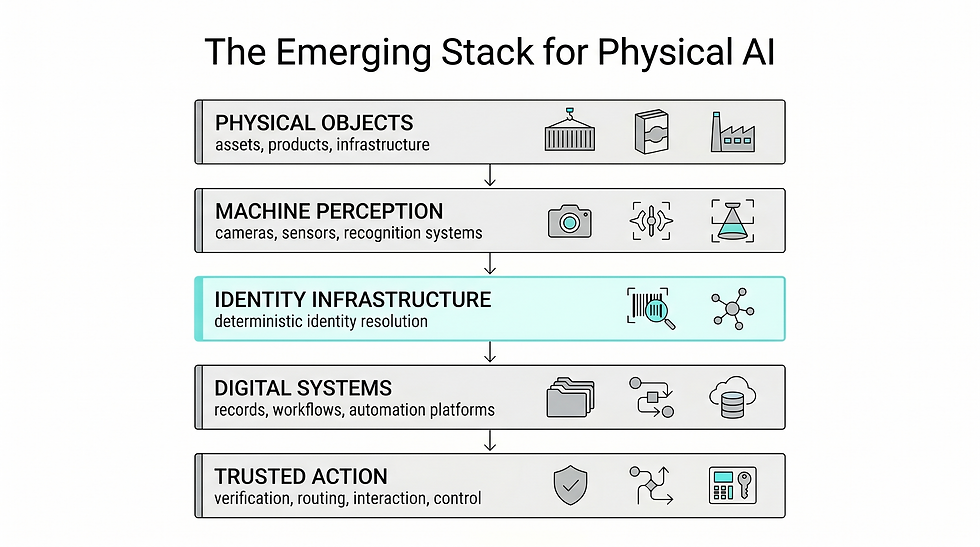
A machine-readable environment requires multiple infrastructure layers working together.
No single layer is enough.
Cameras alone are not enough.
Labels alone are not enough.
AI models alone are not enough.
Digital records alone are not enough.
The environment becomes machine readable only when these layers connect.
1. Machine Perception
Machine perception allows systems to detect and interpret physical environments.
This layer may include:
Cameras
Sensors
Computer vision systems
Recognition models
Edge processing
Environmental detection systems
Machine perception gives machines the ability to see and interpret physical space.
But perception alone remains probabilistic.
It can estimate what something may be.
It does not always determine which specific object is present.
2. Machine-Readable Identity
Machine-readable identity allows physical objects to be distinguished by machines.
This may involve physical markers, encoded identifiers, visual identity systems, or other machine-detectable signals.
The goal is not simply to attach a label.
The goal is to create a reliable connection between a physical object and a digital identity.
Machine-readable identity allows machines to determine:
Which object is present
Whether the object is valid
Whether the identifier is trusted
Which system record applies
This is the foundation for deterministic interaction.
3. Identity Resolution
Identity resolution connects a detected physical identifier to a digital record.
This layer turns a physical signal into system-level meaning.
It answers questions such as:
What object is this?
Is this object trusted?
What record does it belong to?
What status does it carry?
What action should occur?
Without identity resolution, a detected marker or identifier remains only a signal.
With identity resolution, the object becomes part of a digital system.
For more on this layer, see The Identity Layer for the Physical World.
4. Digital System Integration
A machine-readable environment must connect to software systems.
These may include:
Asset management systems
Logistics platforms
Authentication systems
Industrial control systems
Inventory systems
Workflow platforms
Analytics systems
AI decision systems
Digital integration allows machines to act on resolved identity.
This is what turns physical recognition into operational value.
A machine-readable environment does not stop at detection.
It connects what machines see to what systems know.
5. Trusted Action
The final requirement is action.
Once a machine detects an object, resolves identity, and connects that identity to a digital system, it can trigger a workflow.
Examples include:
Route this package
Authenticate this product
Update this asset record
Trigger this inspection
Open this access flow
Deliver this interaction
Flag this object for review
Trusted action depends on verified identity.
Without identity, action is based on estimation.
With identity, action is based on resolved object state.

Why Real-World Conditions Matter
Machine readability must work in physical reality.
Real environments are not clean datasets.
They include:
Distance
Motion
Changing light
Obstructions
Damaged surfaces
Identical-looking objects
Multiple objects in view
Limited connectivity
Operational noise
A system that works only in controlled conditions is not enough for infrastructure deployment.
Machine-readable environments must support reliable operation under variable conditions.
That is why machine readability is an infrastructure challenge, not just a computer vision challenge.
A camera may see the object.
The system must still resolve identity.
The system must still connect to the right record.
The system must still trigger the right action.
Machine-Readable Environments and Physical AI
Physical AI depends on machine-readable environments.
AI systems that operate only in digital spaces work with structured data.
Physical AI systems operate in real spaces.
They need to understand objects, environments, movement, and context.
This requires infrastructure that allows machines to interact with the physical world through identity, not visual estimation alone.
Machine-readable environments provide that foundation.
They allow Physical AI systems to:
Detect physical assets
Resolve specific object identity
Connect objects to digital records
Verify trust
Trigger automated workflows
Support reliable action across environments
Without machine-readable environments, Physical AI remains limited by uncertainty.
With machine-readable environments, machines can interact with physical objects as trusted digital entities.
The Difference Between Machine-Readable Elements and Machine-Readable Environments
It is useful to separate two ideas.
A machine-readable element is an individual object or identifier that a machine can detect.
A machine-readable environment is a full system where detection, identity, resolution, integration, and action work together.
For example, a barcode on a box is a machine-readable element.
But a warehouse becomes machine readable only when that box can be detected, resolved to a specific record, connected to workflow logic, and acted upon automatically.
This distinction matters.
Many environments contain readable elements.
Far fewer are machine-readable systems.
Why This Infrastructure Is Emerging Now
The need for machine-readable environments is growing because machines are entering more physical workflows.
Automation is expanding across logistics, manufacturing, security, infrastructure, retail, media, and mobility.
AI systems are increasingly expected to interact with physical assets.
But many environments still lack the identity infrastructure required for reliable automation.
That creates a gap between what machines can see and what machines can know.
Machine-readable environments close that gap.
They give machines a structured way to connect physical reality to digital systems.
As Physical AI expands, this infrastructure will become increasingly important.
Key Takeaways
A machine-readable environment allows machines to detect objects, resolve identity, connect to digital systems, and trigger reliable action.
Detection alone does not make an environment machine readable.
Recognition identifies object categories, while identity resolves specific physical objects.
Machine-readable environments require perception, identity infrastructure, identity resolution, system integration, and trusted action.
Real-world conditions make machine readability an infrastructure challenge.
Physical AI depends on environments that machines can interpret reliably.
Frequently Asked Questions About Machine-Readable Environments
What is a machine-readable environment?
A machine-readable environment is a physical environment structured so machines can detect objects, resolve identity, connect observations to digital systems, and trigger reliable action.
Is a barcode enough to make an environment machine readable?
No. A barcode may be a machine-readable element, but a machine-readable environment requires detection, identity resolution, digital system integration, and trusted action.
How is machine readability different from computer vision?
Computer vision helps machines detect and classify objects. Machine readability requires the broader infrastructure needed to identify specific objects and connect them to digital systems.
Why do machine-readable environments matter for Physical AI?
Physical AI systems need reliable ways to interpret and act within physical environments. Machine-readable environments provide the identity and integration infrastructure that makes this possible.
What is the role of identity in machine-readable environments?
Identity allows machines to determine which specific physical object is present and connect that object to a trusted digital record.
Conclusion
A machine-readable environment is not created by adding cameras, labels, or sensors alone.
It is created when physical objects can be detected, identified, resolved, connected, and acted upon by machines.
That requires infrastructure.
Machine perception provides awareness.
Identity infrastructure provides certainty.
Digital systems provide context.
Automation platforms provide action.
Together, these layers allow machines to interpret physical environments reliably.
As Physical AI continues to expand, machine-readable environments will become a foundational requirement for trusted interaction between machines, physical assets, and digital systems.
About Sodyo
Sodyo builds the infrastructure that gives physical objects persistent digital identity.
Its platform enables machines and digital systems to resolve identity from the physical world, supporting trusted interaction across engagement, authentication, logistics, and infrastructure environments.


Comments