
Long-Range Visual Scanning vs QR: When Industrial Operations Need More Than Close-Range Codes

Introduction
QR codes changed how people connect physical objects to digital information.
They are inexpensive, familiar, and easy to deploy. For many consumer interactions, they work well. A person stands close to a code, points a phone, and opens a web page, payment flow, ticket, instruction sheet, or product experience.
But industrial operations are different.
Machines, cameras, drones, automated systems, and infrastructure platforms often need to identify objects from farther away. They may need to scan across distance, motion, height, angle, glare, or operational noise. They may need to resolve identity without asking a human to stand nearby and frame the code.
That is where the limitation appears.
QR codes are useful close-range access tools.
They are not designed to be long-range visual identity infrastructure.
As industrial environments become more automated, the question is no longer only:
Can a person scan this code?
The better question is:
Can a machine identify this physical object reliably, from the distance and conditions required by the operation?

What QR Codes Are Good At
QR codes are not the enemy.
They are a strong solution for many close-range, human-initiated interactions.
They work well when:
The user is nearby
The user controls the scanning action
The code can be large enough and clearly visible
The environment is reasonably controlled
The action is low-risk or informational
The goal is to open a URL or retrieve basic encoded data
That is why QR codes are widely used in restaurants, packaging, tickets, posters, payments, visitor flows, and product information.
For these use cases, QR codes are practical.
The problem begins when QR is stretched into workflows it was not designed to support.
A QR code is fundamentally a close-range visual access mechanism. It assumes proximity, visibility, and user participation.
Industrial operations often do not have those conditions.
Where QR Starts to Break Down
Industrial environments create harder scanning requirements.
Objects may be far away. They may be moving. They may be mounted high, viewed from an angle, partially blocked, damaged, dirty, reflective, or surrounded by similar objects.
A machine may need to identify an object while moving through a facility.
A drone may need to identify a location from altitude.
A camera may need to detect an asset across a yard, warehouse, port, road, factory floor, or infrastructure site.
In these cases, close-range QR scanning becomes operationally weak.
Common limitations include:
Short scan distance
Dependency on proper framing
Sensitivity to angle and surface condition
Reduced performance in motion
Difficulty at scale when many objects are visible
Weakness in harsh industrial environments
Human involvement when the workflow should be automated
Limited usefulness for machine-driven identity resolution
The issue is not that QR codes fail everywhere.
The issue is that they were not built as long-range machine-readable infrastructure.
Long-Range Visual Scanning Is a Different Requirement
Long-range visual scanning is not simply a larger QR code.
It is a different operational requirement.
The goal is to let a camera-enabled system detect and interpret a visual identity signal from a meaningful distance, then connect that signal to a digital record or workflow.
That matters because industrial systems often need to answer identity questions before action can occur.
For example:
Which asset is this?
Which package is this?
Which location is this?
Which landing zone is this?
Which component is this?
Which screen, sign, node, or marker is this?
Which system record should be updated?
Which workflow should be triggered?
In these cases, the code is not just a link.
It becomes part of the identity infrastructure.
That is the real difference.
QR was designed primarily for readable data access.
Long-range visual scanning is designed for machine-readable identity.
Industrial Operations Need Distance
Distance changes everything.
In a close-range QR workflow, the user brings the scanner to the code.
In an industrial workflow, the scanner may already be fixed, moving, elevated, mounted, embedded, or autonomous.
The object may not be accessible.
The asset may be across a facility.
The marker may need to be read from a drone, vehicle, camera tower, inspection system, robot, or long-range imaging setup.
When the operation requires distance, the identification system must support that distance.
This matters across environments such as:
Warehouses
Ports
Logistics yards
Manufacturing sites
Energy infrastructure
Transportation systems
Defense environments
Construction sites
Smart city infrastructure
Broadcast and screen-based environments
In each case, the scanning distance is not a convenience feature.
It can determine whether the workflow is possible.
Industrial Operations Need Machine Readability
QR codes are usually scanned by people.
Industrial operations increasingly need scanning by machines.
That shift matters.
A person can adjust their hand, move closer, tilt the phone, try again, wipe the label, zoom in, or use judgment.
A machine needs a more structured input.
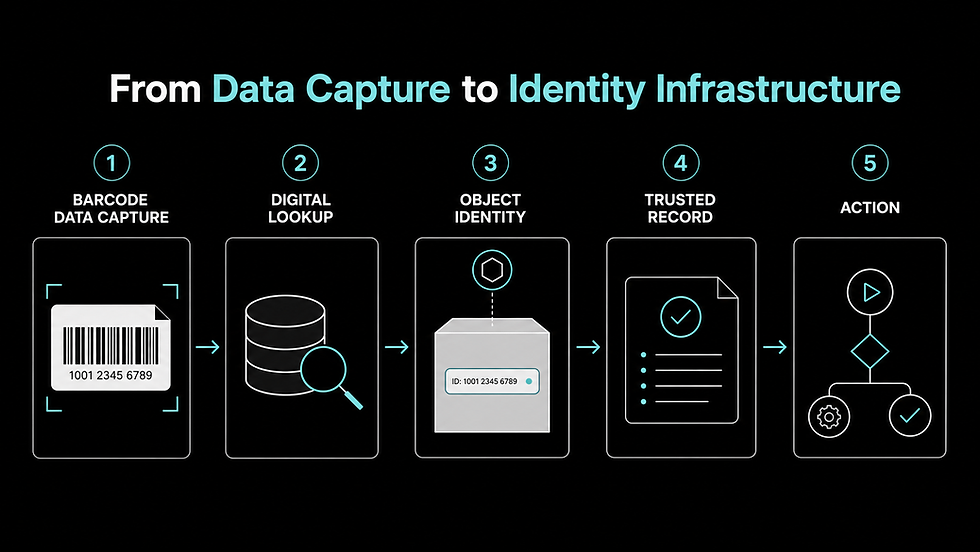
It needs a visual identity system that can be detected, interpreted, resolved, and connected to software logic.
That means the system must support:
Detection
Identity resolution
Connection to digital records
Verification or validation
Workflow execution
Reliable operation under real conditions
This is why long-range scanning is part of a broader machine-readable environment.
The marker or code is only one piece.
The larger requirement is infrastructure that allows machines to connect physical objects to digital systems.
For more on that foundation, see What Makes a Physical Environment Machine Readable.
Recognition Is Not Enough
Industrial cameras and AI models can increasingly recognize objects.
They may detect a pallet, vehicle, container, product, screen, package, or machine part.
But recognition is not the same as identity.
Recognition asks:
What type of object is this?
Identity asks:
Which specific object is this?
That difference matters in industrial operations.
A camera may recognize that it is looking at a container.
But the system may need to know which container.
A drone may detect a landing zone.
But the system may need to confirm which landing zone.
A factory camera may recognize a component.
But the system may need to verify whether that component belongs in the current workflow.
Long-range visual scanning becomes valuable when it connects machine perception to specific identity.
Not just what something appears to be.
Which object it is.
QR Codes Were Built for Access, Not Industrial Identity
QR codes are often used to connect physical surfaces to digital destinations.
That makes them useful for:
Opening a website
Accessing instructions
Viewing product information
Launching a payment
Registering a ticket
Connecting a consumer interaction
These are access-oriented workflows.
Industrial identity is different.
An identity workflow may require the system to determine whether a specific physical object is valid, trusted, assigned, in the right place, connected to the right record, or authorized to trigger an action.
That requires more than opening a destination.
It requires identity resolution.
This is where industrial QR workflows can become fragile. If the system needs object-level trust, workflow integrity, distance, automation, or repeated machine scanning, QR may not be the right infrastructure.
It may still play a role.
But it should not be confused with a full identity layer.
When QR Is Still the Right Choice
There are many cases where QR remains the practical answer.
QR is often the right choice when:
The user is human
The interaction is close-range
The goal is to open a link
The environment is controlled
The cost of ambiguity is low
The workflow does not require long-range machine detection
The object does not need persistent identity resolution
For example, QR is perfectly reasonable for a product landing page, restaurant menu, event registration, instruction page, or customer support link.
The strategic mistake is not using QR.
The mistake is assuming QR can support every physical-digital workflow.
It cannot.
When Industrial Operations Need More Than QR
Industrial operations need more than QR when the system must identify physical objects at scale, from distance, and under real conditions.
That usually happens when the workflow requires:
Long-range scanning
Machine-initiated scanning
Object-level identity
High-throughput environments
Limited human intervention
Integration with systems of record
Reliable operation across motion, angle, and distance
Trusted action based on resolved identity
In these environments, the scanning system becomes part of the operational infrastructure.
The question shifts from:
Can someone scan this?
To:
Can the system reliably identify this object and act on it?
That is a much higher bar.
Why This Matters for Physical AI
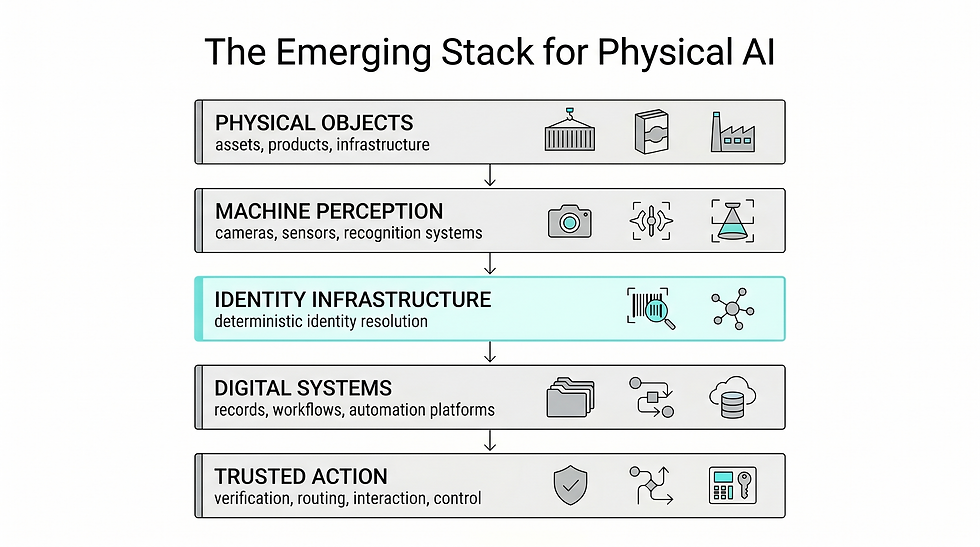
Physical AI depends on machines that can perceive, identify, decide, and act in real environments.
Perception is not enough.
A system may see a physical object but still not know which object it is, whether it is trusted, what record applies, or what action should happen next.
Long-range visual scanning helps close that gap when objects must be identified beyond close-range human interaction.
It supports the move from visual observation to machine-readable identity.
That makes it relevant to:
Autonomous inspection
Logistics automation
Industrial asset tracking
Drone-based identification
Smart infrastructure
Authentication workflows
Machine-readable environments
As Physical AI expands, the ability to identify physical objects at operational distance will become increasingly important.
Key Takeaways
QR codes are useful close-range tools for human-initiated digital access.
Industrial operations often require identification from farther away, under harder real-world conditions.
Long-range visual scanning is not simply a larger QR code.
Industrial systems need machine-readable identity, not just visual data access.
Recognition tells a system what type of object it sees. Identity tells it which specific object is present.
QR remains useful where proximity, human scanning, and simple access are enough.
Long-range visual scanning becomes important when machines must identify objects at distance and connect them to digital systems.
Frequently Asked Questions About Long-Range Visual Scanning and QR
Is long-range visual scanning the same as QR scanning?
No. QR scanning is typically close-range and often human-initiated. Long-range visual scanning is designed for camera-readable identity across greater distances and more demanding operating conditions.
Are QR codes bad for industrial operations?
No. QR codes are useful in the right context. They become limited when industrial operations require distance, automation, object-level identity, or reliable machine scanning under variable conditions.
Why does scan distance matter?
Scan distance matters when the scanner cannot be brought close to the object, or when a machine, drone, camera, or automated system needs to identify assets from farther away.
What is the difference between visual scanning and identity resolution?
Visual scanning detects or reads a visual signal. Identity resolution connects that signal to a specific digital record, object identity, or workflow.
Why does Physical AI need long-range visual identity?
Physical AI systems operate in real environments. They often need to identify specific physical objects before acting. Long-range visual identity helps machines connect what they see to trusted digital systems.
Conclusion
QR codes solved an important problem.
They made it easy for people to connect physical surfaces to digital information.
But industrial operations are creating a different requirement.
Machines need to identify physical objects from farther away, under real-world conditions, and connect those objects to trusted digital systems.
That requires more than close-range scanning.
It requires machine-readable identity infrastructure.
Long-range visual scanning is part of that shift.
It helps industrial systems move from seeing an object to resolving what it is, which object it is, and what action should happen next.
For Physical AI and industrial automation, that distinction matters.
The future is not about replacing every QR code.
It is about recognizing where QR is enough, and where industrial operations require a more capable identity layer.
About Sodyo
Sodyo builds the infrastructure that gives physical objects persistent digital identity.
Its platform enables machines and digital systems to resolve identity from the physical world, supporting trusted interaction across engagement, authentication, logistics, and infrastructure environments.

Comments