
Deterministic vs Probabilistic Identification at Industrial Scale

Introduction
Industrial systems do not operate on casual guesses.
A package must be routed correctly.
A component must enter the right workflow.
A product must be authenticated before action is taken.
An asset must be connected to the right record.
A machine may detect an object. It may classify the object correctly. It may even assign a high probability to what it believes the object is.
But for many industrial environments, probability is not enough.
Industrial automation depends on identification that can support repeatable, reliable action at scale.
This is where the distinction between probabilistic identification and deterministic identification becomes important.
Probabilistic identification estimates what something is likely to be.
Deterministic identification resolves which specific object is present.
That difference is central to Physical AI.
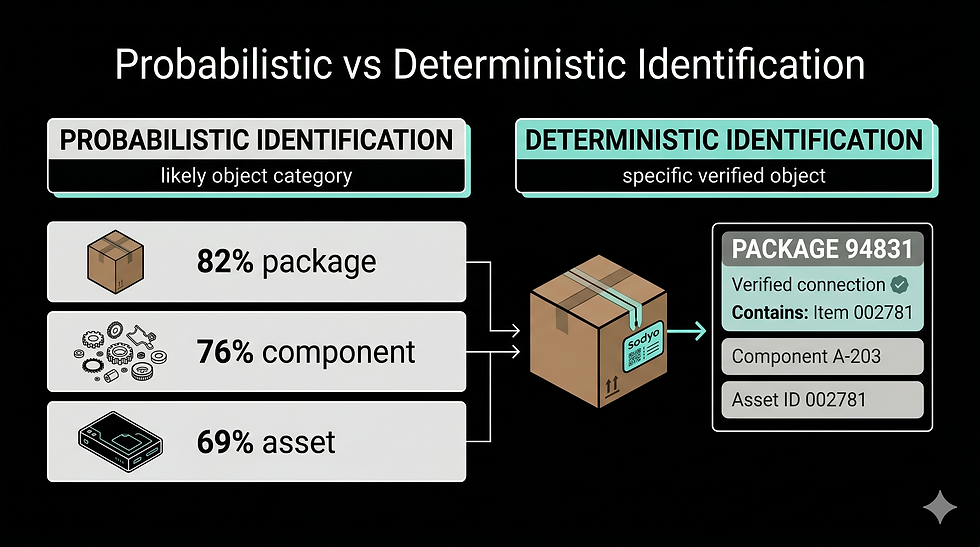
Image prompt:Create a 16:9 technical comparison diagram titled “Probabilistic vs Deterministic Identification”. Use a black background and a clean two-column layout. Left column: PROBABILISTIC IDENTIFICATION with subtitle “likely object category” and examples like 82% package, 76% component, 69% asset. Right column: DETERMINISTIC IDENTIFICATION with subtitle “specific verified object” and examples like Package 94831, Component A-203, Asset ID 002781. Use white or light gray blocks, thin connectors, and subtle Sodyo aqua accents. Keep it minimal, precise, and architectural. Avoid people, robots, stock AI imagery, circuit boards, or decorative effects.
What Is Probabilistic Identification?
Probabilistic identification is based on likelihood.
A system analyzes available signals and estimates what something appears to be.
In machine vision, this often means a model reviews visual input and assigns confidence levels to possible classifications.
For example:
87% likely to be a package
79% likely to be a pallet
72% likely to be a product label
64% likely to be a component
Probabilistic systems are useful.
They help machines interpret complex environments where data may be incomplete, noisy, or variable.
They are especially valuable for object detection, classification, anomaly detection, and pattern recognition.
But probability is not the same as identity.
A system may correctly classify an object as a package without knowing which package it is.
It may recognize a component type without knowing whether that specific component is approved, assigned, authentic, or connected to a valid digital record.
Probabilistic identification answers:
What is this likely to be?
Industrial systems often need a different answer:
Which specific object is this?
What Is Deterministic Identification?
Deterministic identification produces a defined result.
In physical environments, deterministic identification allows a system to determine which specific object is present and connect that object to a digital identity.
For example:
Package 94831
Component A-203
Product Unit 59402
Asset ID 002781
Infrastructure Node 17
Deterministic identification answers:
Which object is this?
That answer matters because industrial workflows are tied to specific objects, not general categories.
A warehouse does not need to know only that something is a package.
It needs to know which package, where it is going, what status it carries, and what workflow should happen next.
A factory does not need to know only that something is a component.
It needs to know whether that component is the correct unit for a specific production process.
An authentication system does not need to know only that something looks like a product.
It needs to know whether that product is valid, trusted, and connected to a legitimate record.
Deterministic identification creates the basis for reliable action.
Why the Difference Matters at Industrial Scale
At small scale, uncertainty may be manageable.
A person can review an exception.
A supervisor can confirm a result.
A worker can rescan an item.
A system can tolerate occasional ambiguity.
At industrial scale, ambiguity compounds.
Thousands of objects may move through a facility.
Multiple machines may operate in parallel.
Assets may look identical.
Workflows may depend on timing, location, status, and permissions.
The cost of uncertainty increases.
A single ambiguous identification may create downstream errors.
A routing mistake may affect delivery.
A wrong component may affect assembly.
A copied identifier may affect authentication.
An incorrect asset association may affect maintenance, compliance, or security.
Industrial systems need identification that can support repeatable execution.
Probability can help interpret the environment.
Deterministic identity enables the system to act.
Recognition Is Not Identification
Recognition and identification are often treated as the same thing.
They are not.
Recognition classifies what something appears to be.
Identification determines which specific object is present.
A machine vision system may recognize an item as a package.
That is recognition.
A deterministic identity system may resolve that item as Package 94831, connected to a specific shipment record.
That is identification.
The distinction becomes critical when systems must trigger action.
If the system only recognizes an object category, it may not know which record applies.
If it resolves identity, it can connect the object to workflow logic.
This is why industrial Physical AI requires identity infrastructure, not perception alone.
Where Probabilistic Identification Works Well
Probabilistic identification is not a failure.
It is an important capability.
It works well when the system needs to interpret broad patterns, classify object types, or detect possible events.
Examples include:
Detecting that a person entered an area
Classifying an object as a vehicle
Identifying a possible defect
Recognizing a general product category
Detecting an anomaly in a visual field
Estimating environmental conditions
In these cases, the system may not need a unique object identity.
A probability score may be enough to trigger review, alert a human operator, or guide further inspection.
Probabilistic systems are useful where interpretation is the goal.
They become insufficient when trusted action depends on specific identity.
Where Deterministic Identification Becomes Necessary
Deterministic identification becomes necessary when a machine must act on a specific physical object.
Examples include:
Routing a package through a logistics network
Authenticating a product
Confirming a component before assembly
Updating a specific asset record
Triggering an inspection workflow
Granting access based on physical identity
Connecting a physical interaction to a verified digital record
In these environments, the system cannot rely only on likelihood.
It needs a resolved identity.
This is especially important when workflows involve:
Safety
Security
Compliance
Authentication
Inventory integrity
Financial value
Operational continuity
The higher the consequence of error, the more important deterministic identification becomes.

Why Industrial Environments Make Identification Harder
Industrial environments are complex.
They are not clean visual datasets.
They include:
Motion
Distance
Repetition
Occlusion
Changing light
Similar objects
Damaged labels
Multiple objects in view
Harsh operating conditions
Limited connectivity
High throughput
These conditions make identification harder.
A system may see several similar objects at once.
It may detect the object type correctly but fail to determine which specific object is present.
It may encounter a copied label, misplaced marker, damaged surface, or incomplete signal.
At industrial scale, these problems are not exceptions.
They are normal operating conditions.
That is why identification infrastructure must be designed for physical reality.
The Role of Identity Infrastructure
Identity infrastructure allows machines to move from observation to certainty.
It gives physical objects a way to be resolved by digital systems.
This infrastructure may include:
Machine-readable identity markers
Recognition systems
Identity resolution platforms
Verification mechanisms
Systems of record
Workflow integrations
The goal is not simply to make an object visible.
The goal is to make the object identifiable.
When a machine detects an identity signal, the system must be able to resolve that signal to a specific digital record.
That record may define ownership, status, authenticity, destination, permissions, workflow state, or action logic.
This is what allows industrial systems to act reliably.
For more on this layer, see The Identity Layer for the Physical World.
Deterministic Identification and Physical AI
Physical AI systems interact with real environments.
They need to perceive, identify, decide, and act.
Probabilistic recognition supports perception.
Deterministic identification supports trusted action.
Both are useful.
But they serve different roles in the Physical AI stack.
A Physical AI system may use probabilistic models to detect that an object is present.
It may then use deterministic identity infrastructure to resolve which specific object is present.
Once identity is resolved, the system can connect to digital records and trigger action.
This sequence matters:
Perception
Recognition
Identification
Resolution
Action
Without deterministic identification, Physical AI systems remain dependent on visual estimation.
With deterministic identification, physical objects become trusted digital entities that machines can work with reliably.
Deterministic Identification Is Not Just Accuracy
Accuracy is important, but deterministic identification is not only about improving recognition accuracy.
A model can become more accurate at classifying objects and still fail to resolve specific identity.
For example, a system may become excellent at recognizing pallets.
But it still may not know which pallet is present.
A system may correctly recognize a luxury product.
But it still may not know whether that specific product is authentic.
A system may detect a machine component.
But it still may not know whether the component belongs in the current workflow.
The issue is not only visual accuracy.
The issue is identity resolution.
Industrial systems need more than better recognition.
They need infrastructure that connects physical objects to digital identity.
Why This Matters for the Future of Industrial Automation
Industrial automation is moving toward more autonomous, machine-driven workflows.
Systems are expected to operate faster, across more environments, with less manual intervention.
That creates a higher requirement for identity.
Machines must know what they are interacting with.
They must know whether it is trusted.
They must know what digital record applies.
They must know what action is permitted.
Probabilistic identification will remain important for perception and classification.
But deterministic identification will become essential for workflows that require trust, verification, and repeatable execution.
The future of industrial automation depends on both.
But only deterministic identification can support trusted object-level action at scale.
Key Takeaways
Probabilistic identification estimates what an object is likely to be.
Deterministic identification resolves which specific object is present.
Recognition is useful, but recognition is not identity.
Industrial environments increase the cost of uncertainty.
Probabilistic systems are useful for perception and classification.
Deterministic identification is required for trusted action at industrial scale.
Physical AI depends on identity infrastructure that connects physical objects to digital records.
Frequently Asked Questions About Deterministic and Probabilistic Identification
What is probabilistic identification?
Probabilistic identification uses likelihood or confidence scoring to estimate what an object appears to be.
What is deterministic identification?
Deterministic identification resolves the specific identity of a physical object and connects it to a digital record.
How is deterministic identification different from recognition?
Recognition identifies the category or type of object. Deterministic identification determines which specific object is present.
Why is probabilistic recognition not enough for industrial automation?
Probabilistic recognition may classify an object correctly but still fail to determine which specific object is present. Industrial workflows often require object-level identity before action can occur.
Why does Physical AI need deterministic identification?
Physical AI systems need deterministic identification to connect physical objects to digital records and trigger reliable action in real-world environments.
Conclusion
Probabilistic identification helps machines interpret the physical world.
It supports detection, classification, and pattern recognition.
But industrial automation often requires more than likelihood.
It requires identity.
Deterministic identification allows machines to determine which specific object is present, connect that object to a digital record, and trigger trusted action.
At industrial scale, this distinction matters.
A machine that recognizes an object category may still act on incomplete information.
A machine that resolves identity can connect physical reality to digital logic.
As Physical AI expands into industrial environments, deterministic identification will become a foundational requirement for trusted automation.
About Sodyo
Sodyo builds the infrastructure that gives physical objects persistent digital identity.
Its platform enables machines and digital systems to resolve identity from the physical world, supporting trusted interaction across engagement, authentication, logistics, and infrastructure environments.


Comments