


The Vertical Incubation Engine
Proving protocol viability across the next generation of industrial applications.
Where New Capabilities Become Future Platforms
Sodyo Labs explores the next frontiers of visual recognition — pushing performance beyond conventional limits of distance, mobility, and operational environments.
Capabilities developed within Sodyo Labs are not theoretical. They are built, tested, and measured under real-world conditions before becoming part of future Sodyo platforms.
Our current development focus includes three core capability areas:
Extreme Distance Recognition
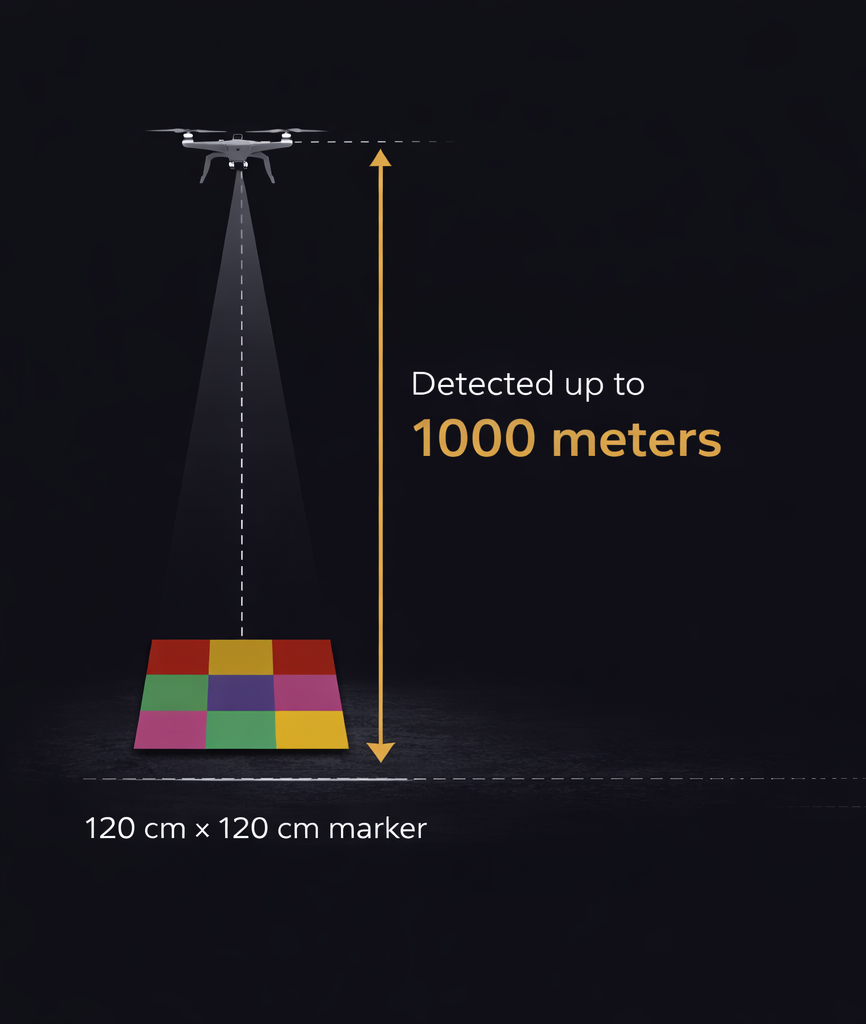
Detecting large markers at distances up to 1000 meters, and compact markers at distances up to 100 meters — far beyond conventional scanning limits.
Aerial and Mobile Recognition
Supporting reliable detection from moving platforms, including autonomous aerial systems such as drones.
Operating Across Complex Environments
Building systems that perform reliably across large outdoor areas, changing terrain, and unpredictable environments.
Sodyo Labs has demonstrated reliable visual marker detection at distances that extend far beyond conventional scanning systems.
Lab-validated operational benchmarks:
-
120 cm × 120 cm marker detected at distances up to 1000 meters
-
12 cm × 12 cm marker detected at distances up to 100 meters
These performance levels enable recognition across environments where proximity-based systems are impractical, allowing systems to identify targets before close-range interaction is required, expanding how recognition can be deployed across large areas.
KEY CAPABILITIES INCLUDE:
-
Early identification of designated zones
-
Reduced reliance on dense scanning infrastructure
-
Reliable operation across large outdoor environments
-
Visual confirmation across wide operational areas
PROJECT:
Extreme Distance Recognition
Sodyo Labs is extending visual recognition capabilities into aerial and mobile environments, enabling reliable marker detection from moving platforms such as autonomous aerial systems.
Validated Under Real-World Flight Conditions
Testing and validation efforts are conducted using drone platforms operating under controlled and real-world flight conditions. These evaluations support reliable long-range detection while accounting for motion, altitude, and environmental variability.
Drone-based recognition extends long-distance detection into dynamic flight environments where movement introduces additional operational complexity. Reliable detection during motion enables systems to confirm locations, zones, and assets without requiring stationary infrastructure.
KEY CAPABILITIES enabled:
-
Visual identification during active flight
-
Autonomous landing zone confirmation
-
Reliable recognition without stationary infrastructure
-
Continuous detection across dynamic environments
PROJECT:
Aerial and Mobile Recognition

Sodyo Labs develops recognition systems designed to operate reliably across large outdoor environments where terrain, lighting, and environmental conditions are unpredictable.
Designed for Variable Operational Conditions
Testing includes deployments across diverse terrain types and environmental conditions, ensuring reliable detection performance even when visibility, orientation, or environmental stability cannot be controlled.
Reliable recognition across complex environments enables consistent identification of designated markers without requiring highly controlled conditions. Systems remain operational across changing terrain, weather variability, and large physical areas.
KEY CAPABILITIES enabled:
-
Reliable recognition across uneven terrain
-
Stable operation under variable lighting conditions
-
Visual confirmation across large distributed environments
-
Deployment in environments where precision infrastructure is impractical
PROJECT:
Operating Across Complex Environments
